| Naval Aviation. III |
|
Catalogue number 131048 Caudron G3 floatplane With a short crew nacelle and single nose engine, the G3 of 1913-1914 was a reconnaissance aircraft initially with wing warping for lateral control. The wheeled version was sold to many countries and a float version trainer was made for the Chinese. 14cm x 9cm Matt gelatin silver print |
 |
|
Catalogue number 131113 Gourdou-Leseurre on the catapult Floatplane on its catapult whilst the French cruiser is underway, note the elaborated cover for the engine. 11.3cm x 8cm Gelatin silver print |
 |
|
Catalogue number 121084 Gourdou-Leseurre GL832 Two crew getting ready for a catapult launch. A smiling pilot, note the sturdy headrest to cope with whiplash of the head during catapulting. Verso:"22nd January 1937, from our special envoy. Major naval manoeuvres. The Atlantic fleet is operating at present off the coast of French West Africa and is testing the latest technical progress of its equipment. The floatplane, piloted by Lieutenat de vaisseau Tellier, is ready to be catapulted" in French 15.9cm x 12cm Gelatin silver print |
 |
|
Catalogue number 103054 Gourdou-Leseurre G812 on take-off A crew of three: pilot, gunner with scarff ring and navigator/observer. Verso:"Toulon 1934" in light blue ink 14cm x 8.5cm Gelatin silver print |
 |
|
Catalogue number 103055 Gourdou-Leseurre GL812 This Goudrou-Leseurre is flying off the islands near Marseille, pilot, gunner and navigator/observer. Verso:"1932" 13.9cm x 8.7cm Gelatin silver print |
 |
|
Catalogue number 134049 Gourdou-Leseurre moored to buoy Photograph taken at Cherbourg, note the Breguet and destroyers in the background. Verso: Franked 1924 13.4cm x 8.3cm Gelatin silver print |
 |
|
Catalogue number 126097 Prototype Dewoitine H780 in the workshop The Armistice of 1940 put an end to the development of this floatplane derived from the land-based Dewoitine D520 of which the French Aeronavale had several examples. Only one H780 was made and it never flew. Note handrail on the fusalage by the cockpit. Credt: PhotoArchives U.P.E. 11.8cm x 6.8cm Gelatin silver print |
 |
|
Catalogue number 126096 Dewoitine HD730 The prototype reconnaisance floatplane, armed with two 7.5mm machine guns, to be embarked on warships of the French Navy. Note twin tail and inverted gullwing wings, aircraft on launching trolly. The two prototypes flew in 1940 but, as for the H780, the Armistice eventually brought further develpment to a halt. Credt: PhotoArchives U.P.E. 11.7cm x 6.4cm Gelatin silver print |
 |
|
Catalogue number 136075 Latecoere 29 on the Etang de Berre A torpedo bomber from the 1930s, this version has the Hispano-Suiza engine but the aircraft was already obsolete at the beginning of the war. Note the rear gunner's turret. The first production Latecoere 29s went to the 4TI squadron at Berre, South of France. Verso:"Latecoere on the apron at Berre" in French and in light pencil 6.2cm x 4.5cm Gelatin silver print |
 |
|
Catalogue number 94097 Heinkel He 60 From the outset in 1933, the He 60 was under-powered and suffered from a lack of performance in part due to its solid construction (and as a consequence its small useful load) to face the demanding conditions of imposed rough water requirements in the German Navy specification. By 1939, the better-performing Arado 196 was taking its place as the shipboard floatplane. Verso:"Heinkel sea reconnaissance He 60 of the German Navy" in Dutch 14.8cm x 10.4cm Gelatin silver print |
 |
|
Catalogue number 100009 Two-man crew of a Heinkel He 60 The crew on the float seems wary about getting his shoes wet. Note the barrel of the rear machine gun pointing towards the tail. 14cm x 8.7cm Gelatin silver print |
 |
|
Catalogue number 88 Arado Ar 196 floatplane After the failure to improve the performance of catapultable Heinkel He 60, the Arado Ar 196 became the standard reconnaissance observation floatplane for the German Navy in World War Two. The large canopy gave a good all-round view and two 7.92mm MG 17 machine guns, one in the starboard forward fuselage (note blister in this photograph) and a second on a movable mounting in the cockpit provided only a moderate defence against attack. As experience was gained in operations, the armament was improved. Noting the arrangment of the float struts, the aircraft in this photograph appears to be an Ar 196A-3 but still with the two MG17s. 35cm x 26.2cm Matt gelatin silver print |
 |
|
Catalogue number 30042 The successful Heinkel 115 This large German torpedo bmber/reconnaissance/minelaying floatplane was considered by some as the most successful floatplane of the Second World War because of its stability even a low speeds, performance and good water handling qualities. Verso:"Multi-purpose seaplane Heinkel He 115" in German and typed text Credit: Publisher Noraweno 12.3cm x 8.5cm Matt gelatin silver print |
 |
|
Catalogue number 68067 Heinkel He 115 Seen from above, we can appreciate the important wing surface of the He 115 - span 22.5m, wing area 86.7m². Note the crewman on the port wing with the aircraft taxiing and the ladders from the floats to the fuselage. We can see a 7.9mm machine gun at the rear of the cockpit, as Allied fighter performance increased, the defensive armament of the He 115 was improved with more machine guns and a 20mm cannon in the nose. Credit: Droppel 13cm x 8.3cm Gelatin silver print |
 |
|
Catalogue number 128015 Hawker Osprey onboard Swedish cruiser Gottland, 1938 Gottland was something of a hybrid cruiser with the latter part of the deck dedicated to storage, launching and the recovery of Hawker Osprey floatplanes. There is some controversy as to who built these floatplanes. Some say that the eight aircraft were built under licence in Sweden and were powered by Swedish Pegasus engines built under licence from Britain (see Internet for "The Story of Sweden's Hawker S9 Ospreys"). Sturtivant and Crown give the aircraft as "Overseas Production 8 built under licence" in the major reference work "Fleet Air Arm Aircraft, Units and Ships 1920 to 1939". The most likely explanation comes from Mason (Hawker Aircraft since 1920) who indicates that the Swedish Government ordered four Bristol Pegasus-engined Ospreys in 1933 for the future aircraft-carrying cruiser Gottland and being delivered in 1935. A second series of Ospreys was built under licence in Sweden. Note the spare float by the starboard guard rail and the rail tracks for moving aircraft to and from the stern catapult. Verso:"Swedish battleship(sic) 12 June 1938" in French and in light blue ink 11.8cm x 6.7cm Matt gelatin silver print |
 |
|
Catalogue number 135074 Hawker Osprey K3629 K3629 has just been catapulted of the Royal Navy cruiser H.M.S. Sussex, note how the forward supports of the trolly have folded down to release the floatplane. Sussex was on an Australian cruise 1934 when K3629 was attributed to her. Verso:"HMS Sussex The seaplane just as she has been catapulted" in light pencil 13.4cm x 8.3cm Gelatin silver print |
 |
|
Catalogue number 35091 Hawker Osprey S1681, 1933 S1681, delivered 1932, had interchangeable wheels or Short F.45 floats, she is seen here flying over H.M.S. Eagle. Note sighting tube in front of the pilot and over the forward fusilage, the Osprey was armed with a forward-firing Vickers mkIII machine gun to port and a Lewis gun on a rear cockpit mounting. Credit: "Aeroplane" 13.3cm x 7.5cm Gelatin silver print |
 |
|
Catalogue number 35255 H.M.S. Exeter with Hawker Ospreys, K2275 and S1697 These two floatplanes were on Exeter in 1933, with no hangar, they were exposed to the elements. S1697, delivered 1933, went to the 2nd Cruiser Squadron and K2275 moved around the same squadron being with Exeter at the end of 1933. Verso:"Exeter Anglais" in black ink 9cm x 14cm Matt gelatine print |
 |
|
Catalogue number 142041 Dutch Fokker C14 W This is a photograph of the first production Fokker C14 W reconnaissance and trainer floatplane F1 of 1939, armed with two 7.9mm machine guns, one fixed forward-firing and a second trainable in the observer's cockpit. Verso:"Light reconnaissance seaplane Fokker C 14 W" in Dutch 13.7cm x 9 cm Gelatin silver print |
 |
|
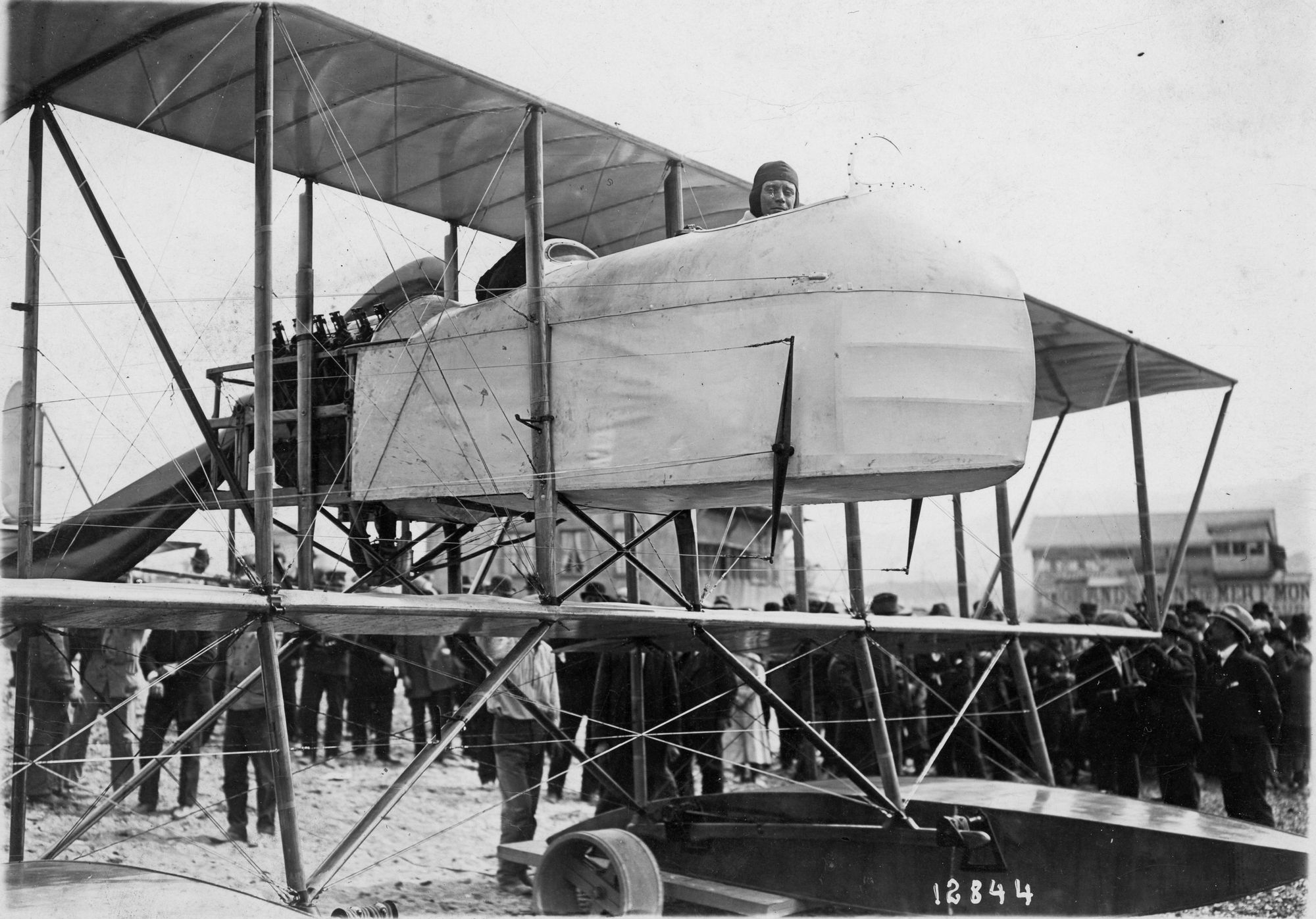
Catalogue number 131004 Farman Pusher floatplane This looks like a Farman MF9 floatplane, notably because of the vertical tail fin edge and the very basic windshields for the two-man crew. The MF9 was a reconnaissance bomber. Credit: Rol, Paris 16.5cm x 12cm Gelatin silver print |
 |
|
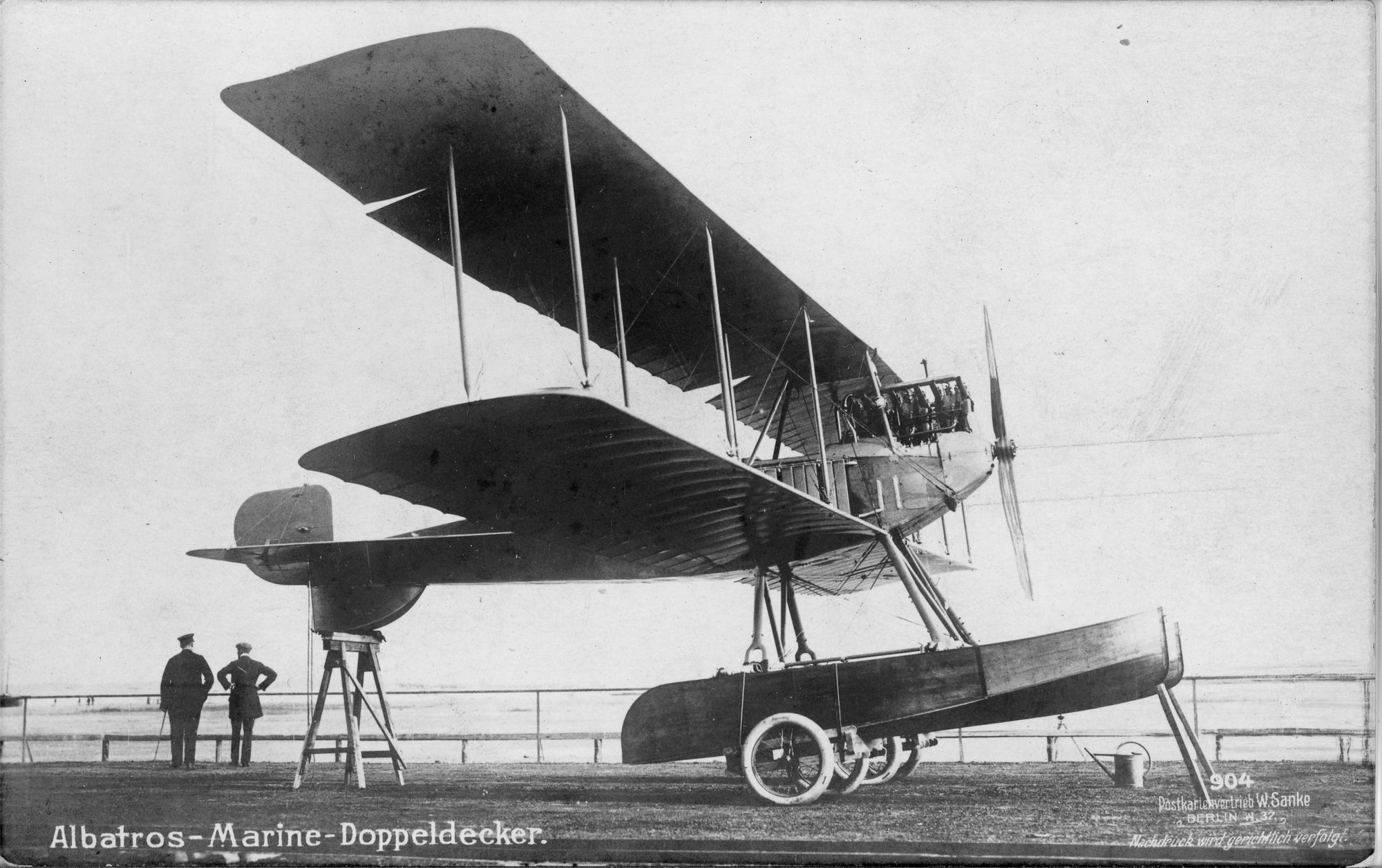
Catalogue number 130056 Albatros W8 floatplane, 1918 The two-seater Albatros was powered by an eight-cylinder, water-cooled Benz engine and had one fixed Spandau machine gun firing forward and one Parabellum machine gun on a flexible rear mounting. Note the radiator on the starboard fuselage and the finely-built wooden floats, like small boats! (The illustration of the Albatros W8 in "German Aircraft of the First World War, Thetford and Grey, 1962 does not resemble the photograph shown here.) Credit: W. Sanke, Berlin Recto:"Albatros Marine Biplane" in German 13.6cm x 8.5cm Matt gelatin silver print |
 |
|
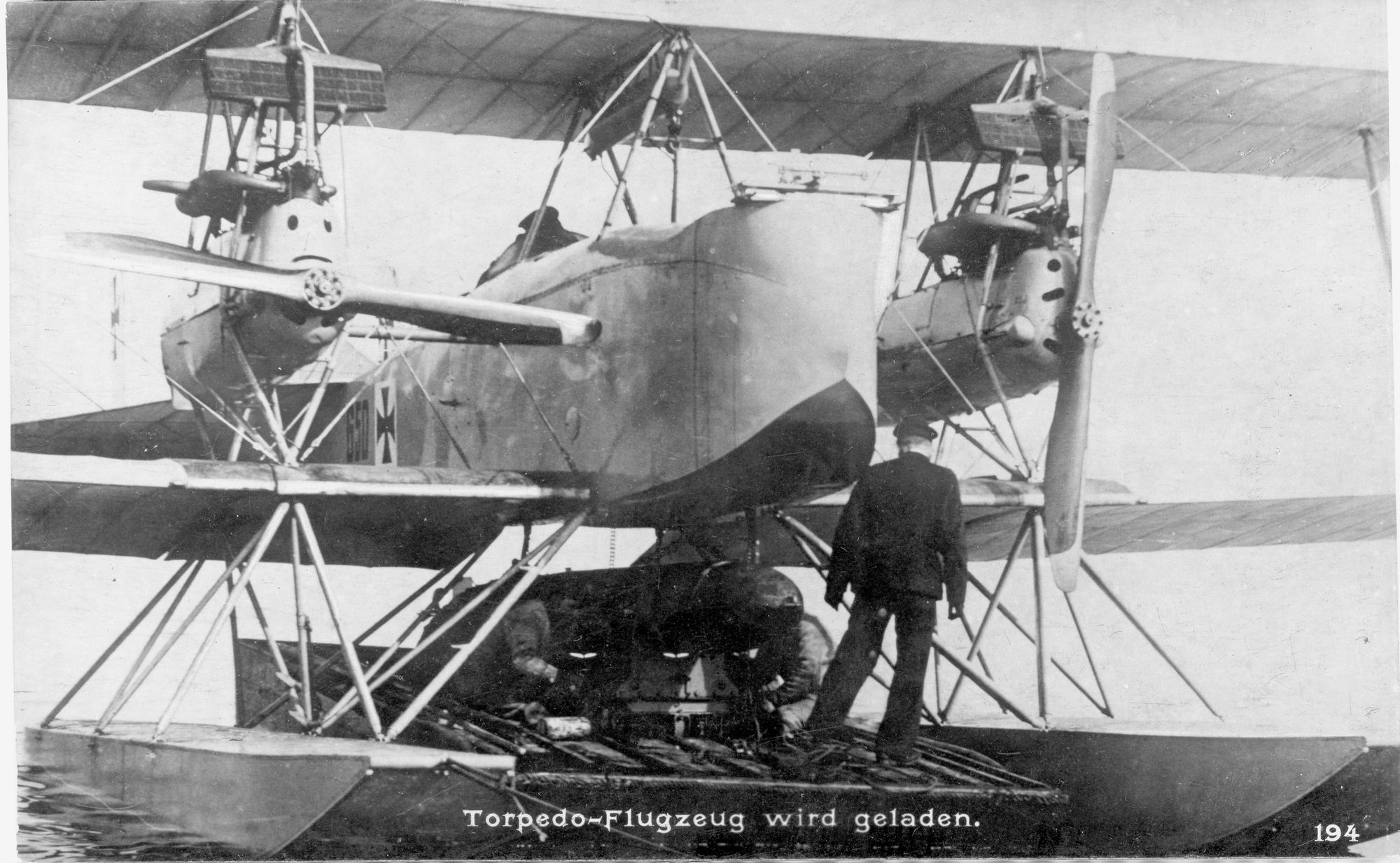
Catalogue number 150004 Friedrichshafen FF41at floatplane torpedo bomber, serial number 650 An interesting photograph showing German sailors loading a torpedo to the fuselage of a Friedrichshafen FF41at floatplane, note the raft-like structure used to carry the torpedo. Crew of three, twin Benz Bzz. III 6 cylinder inline engines in smart metal housings and with water cooling, see radiators above each engine. We can see the gun mounting in the cockpit forward for a Parabellum MG14 gun. We have not found reference to a FF41at with the serial number 650. Recto:"Loading a torpedo plane" in German 13.5cm x 8.4cm Gelatin silver print |
 |
|
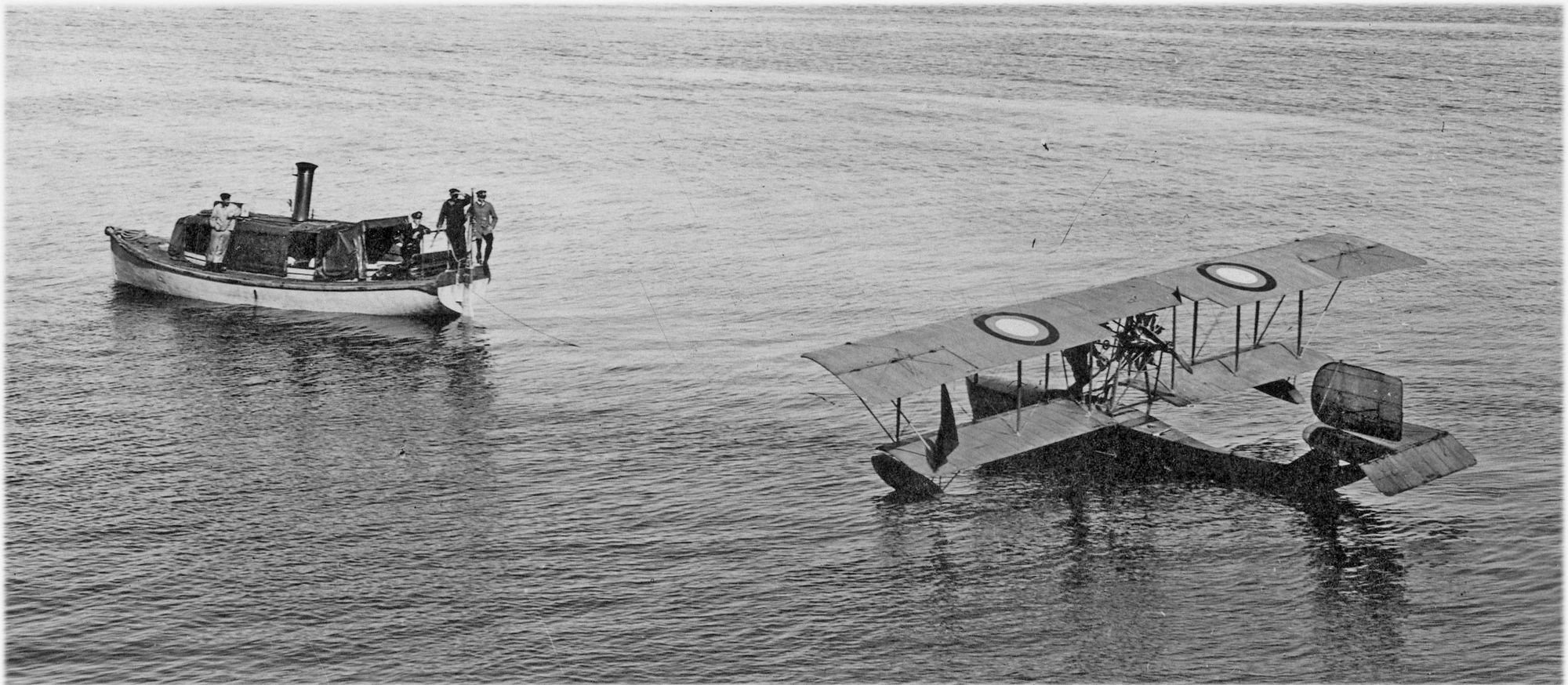
Catalogue number 141113 German picket boat with floatplane This looks like the Gregorovich M5 with a single tail elevator, a large rounded tail fin and diagonal struts from the upper wing to the base of outer vertical struts of the lower wing. Verso:"Russian floatplane with pinasse from S.M.S. Santa Elena" in German and in light pencil 13.8cm x 8.7cm Matt gelatin silver print |
 |
|
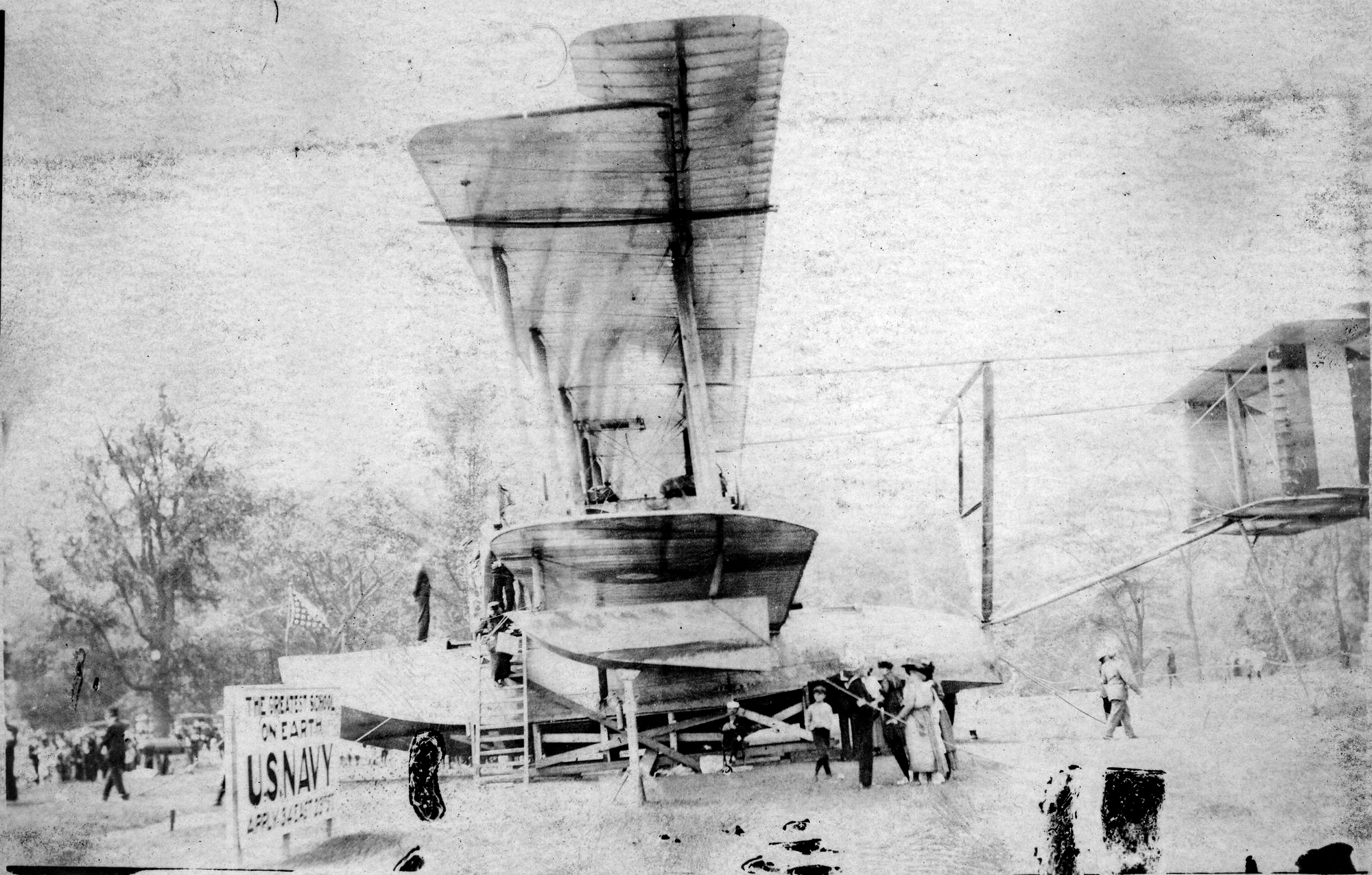
Catalogue number 140133 Curtiss NC flying boat The Curtiss NC (for "Navy/Curtiss") flying boat was an exceptionally large American aircraft for it's time (design 1917, first flight 1918). Built to counter the Atlantic U-boat menace, the demand was for a flying boat that could patrol the Atlantic for 15 to 20 hours. However, the NC boats arrived after the end of the war. The original design was for three tractor engines but in an exercise to fly across the Atlantic, a fourth pusher engine was installed as we can just make out in the photograph, the propeller is above the lower wing and behind the rear strut. One of the boats (NC-4) made a tour of eastern and southern coastal cities to celebrate the transatlantic race and it is probably this boat that is in the photograph. 13.8cm x 8.5cm Gelatin silver print |
 |
|
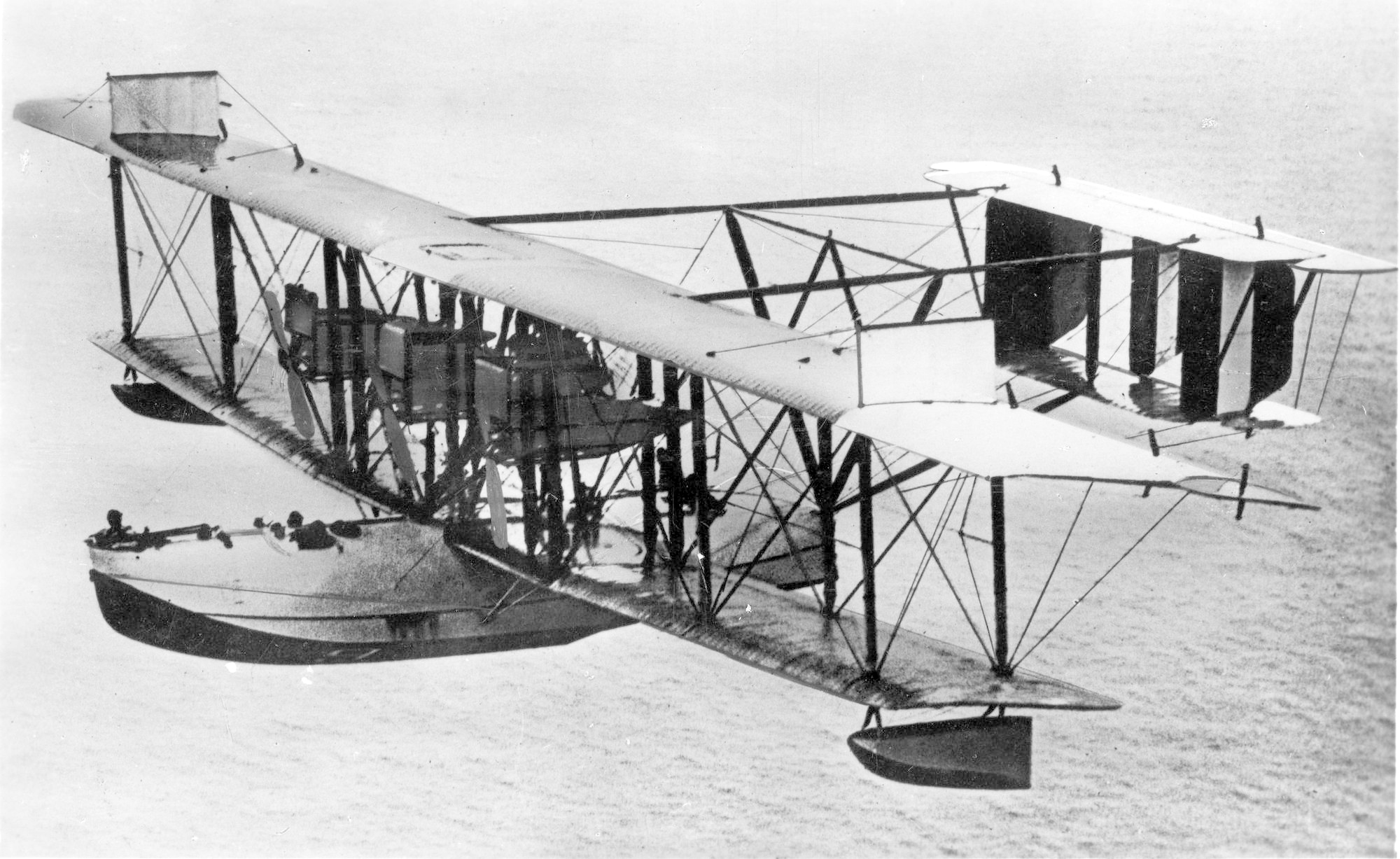
Catalogue number 106009 Curtiss NC flying boat, 1921 Built after the war, Curtiss NC9 in the air, with the three Liberty engines as tractors. The rear gunner had a clear field of fire. The standard crew was six, here we can see the navigator/nose gunner (there was also a gun mount in the rear hull cockpit), the two pilots side by side and at the back, two other crew (radio operator and two flight engineers were included). 13cm x 8.2cm Gelatin silver print |
 |
|
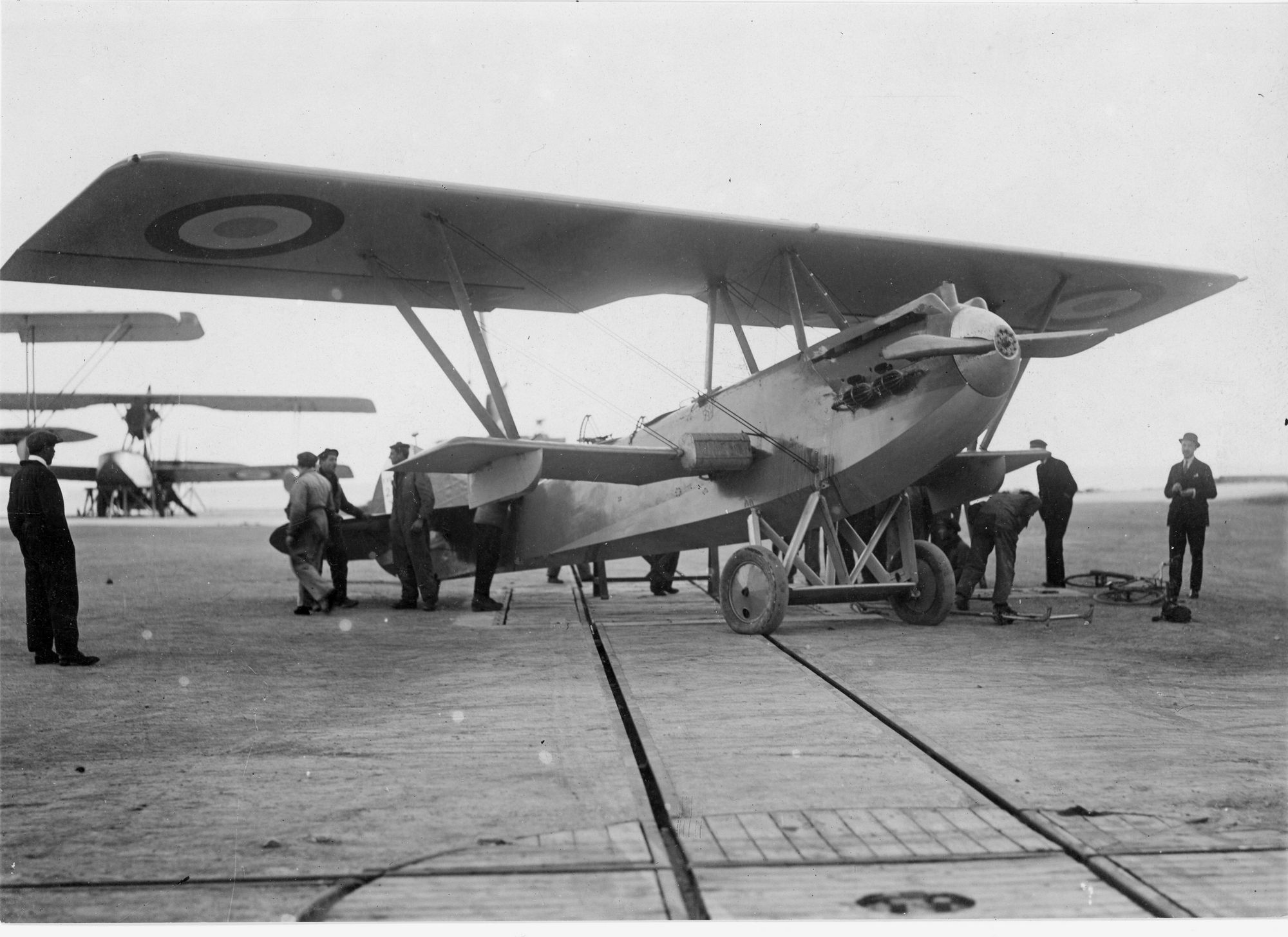
Catalogue number 139030 Villiers type 2 flying boat Although 32 were built, the Villiers type 2 had a short life of just two years after its introduction in 1927. The idea was to have a land/carrier-based fighter aircraft that could land on the sea if necessary, the undercarriage being retracted in the event. The aircraft were based at the naval air base at Hyeres and never flew from the Bearn, the French aircraft carrier of the time. Note the sequestrial lower wing arrangement, reduced drag and weight but retaining the structural strength of the wings. Verso:"Avion marin de chasse VILLIERS TYPE 2 LORRAINE 450hp" in red-inked stamp 16.3cm x 11.6cm Gelatin silver print |
 |
|
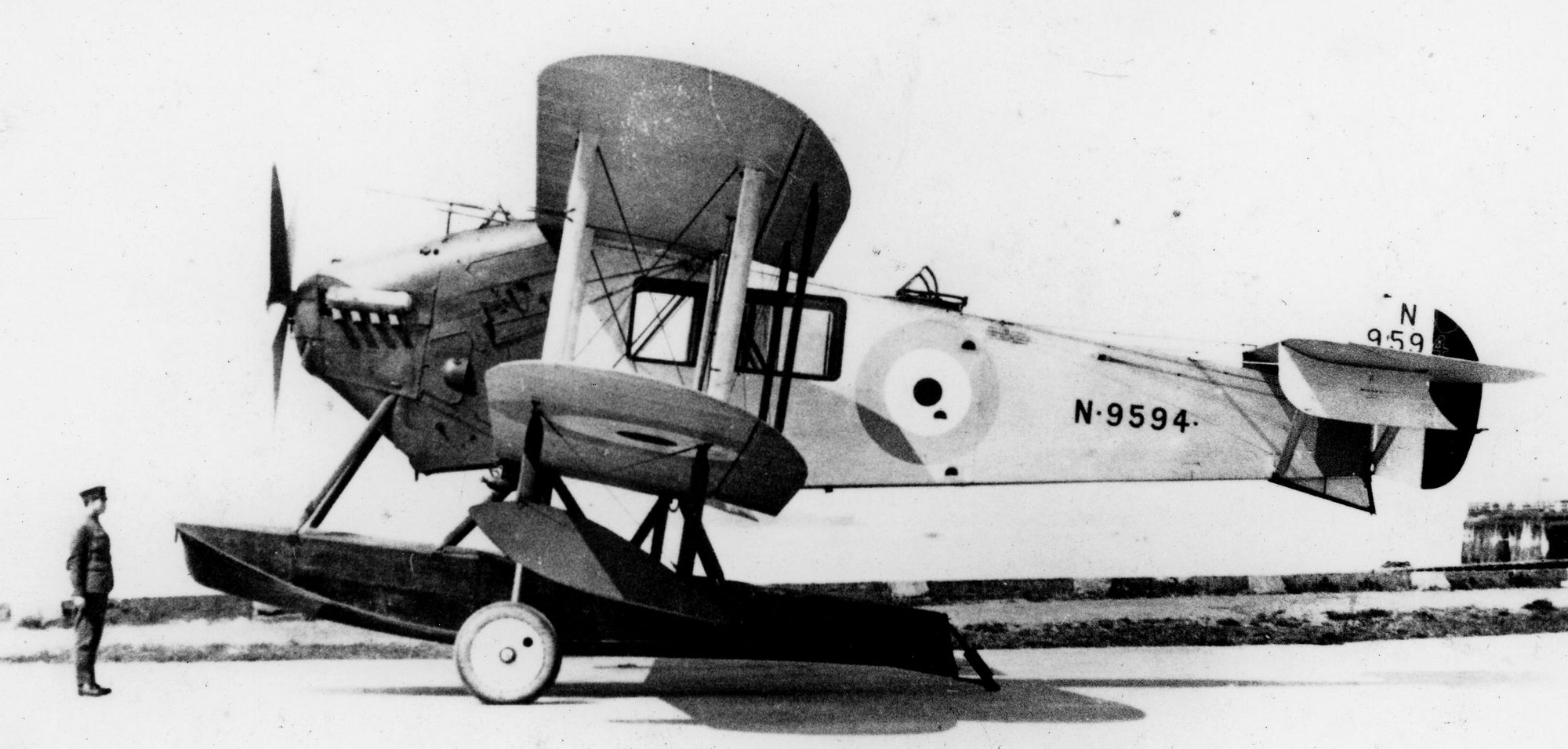
Catalogue number 105026 Avro Bison N9594, an amphibious floatplane For reconnaisance over the sea and fleet spotting, this bulky aircraft needed a large cabin for radio and navigation equpment, with large observation windows for the observers who could stand up. There was a rear gunner with a Lewis gun and a fixed forward-firing Vickers gun, note the gun sights forward of leading edge and inversed fins on tail elevators. First flight 1921, retired 1929 to be replaced by the Fairey IIIF. This aircraft was the only Bison converted to an amphibian with a central float and retractable wheels but this version never went into production. Verso:"Avro 555B Bison I Amphibian 15.8cm x 10.3cm Gelatin silver print |
 |
|
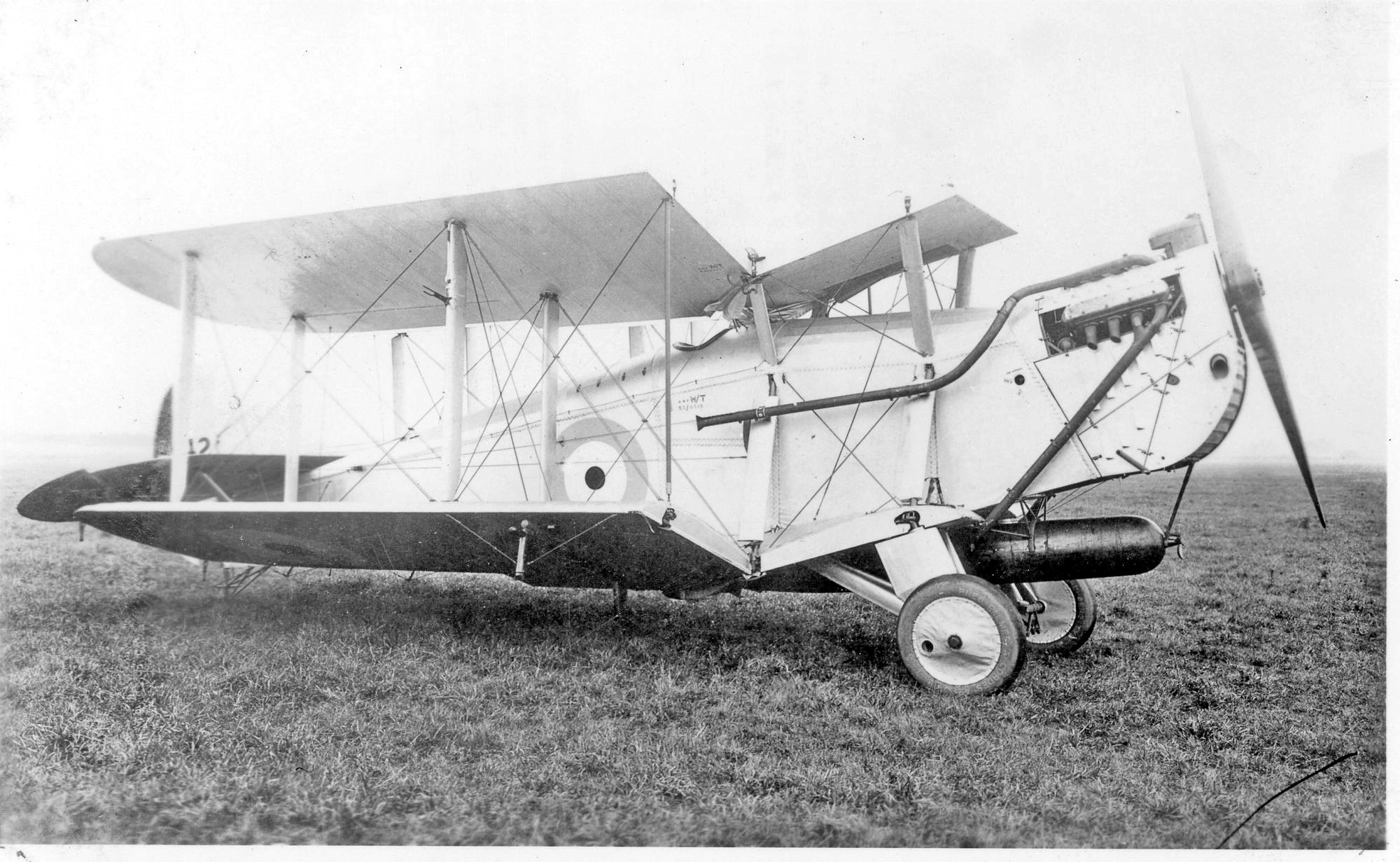
Catalogue number 150002 Blackburn Dart N9542 This Blackburn Dart with wings folded back is probably N9542 from 1922 loaded with a mk VIII or mk IX 18-inch naval torpedo, the aircraft did not have a gun. Powered by the Napier Lion IIB engine, note the complicated system of exhaust manifolds. Although looking cumbersome, the Dart was a difficult aircraft to "shoot down" in Fleet exercises because it could manoeuvre at speeds (stall speed 38 knots) at which a fighter would stall. Darts went to the carriers Eagle and Furious in the early 20s and enabled the Fleet Air Arm to develop the theory and practice of torpedo attacks. Credit: Aeroplane Photo Supply, Canada 10.4cm x 6.4cm Gelatin silver print |
 |
|
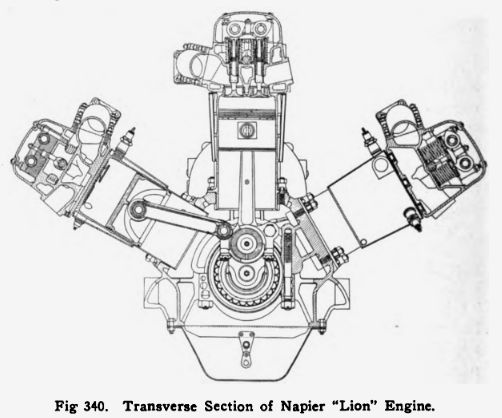
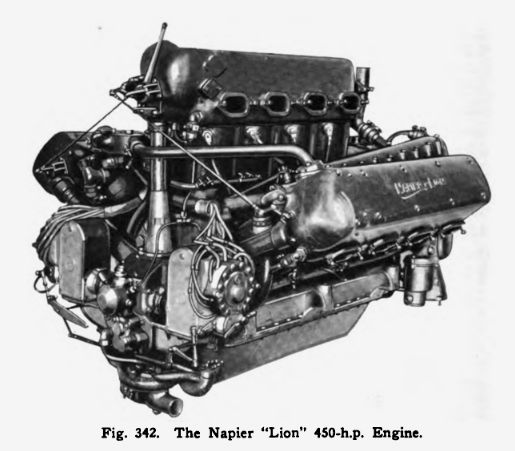
Catalogue number The Napier Lion engine The Napier Lion engine was one of the best aero engines in the interwar period. The twelve cylinders were arranged in a fanshape of three four-cylinder blocks, one vertical and the other two at 60 degrees hence imposing an elaborate system of exhaust pipes. Top Traverse line drawing . Bottom Three quarter view of the engine block Credit: From "Airplane Engine Encyclopedia", G.D. Angle, The Ottebein Press, 1921 Printed image Printed image |
 |
 |
|
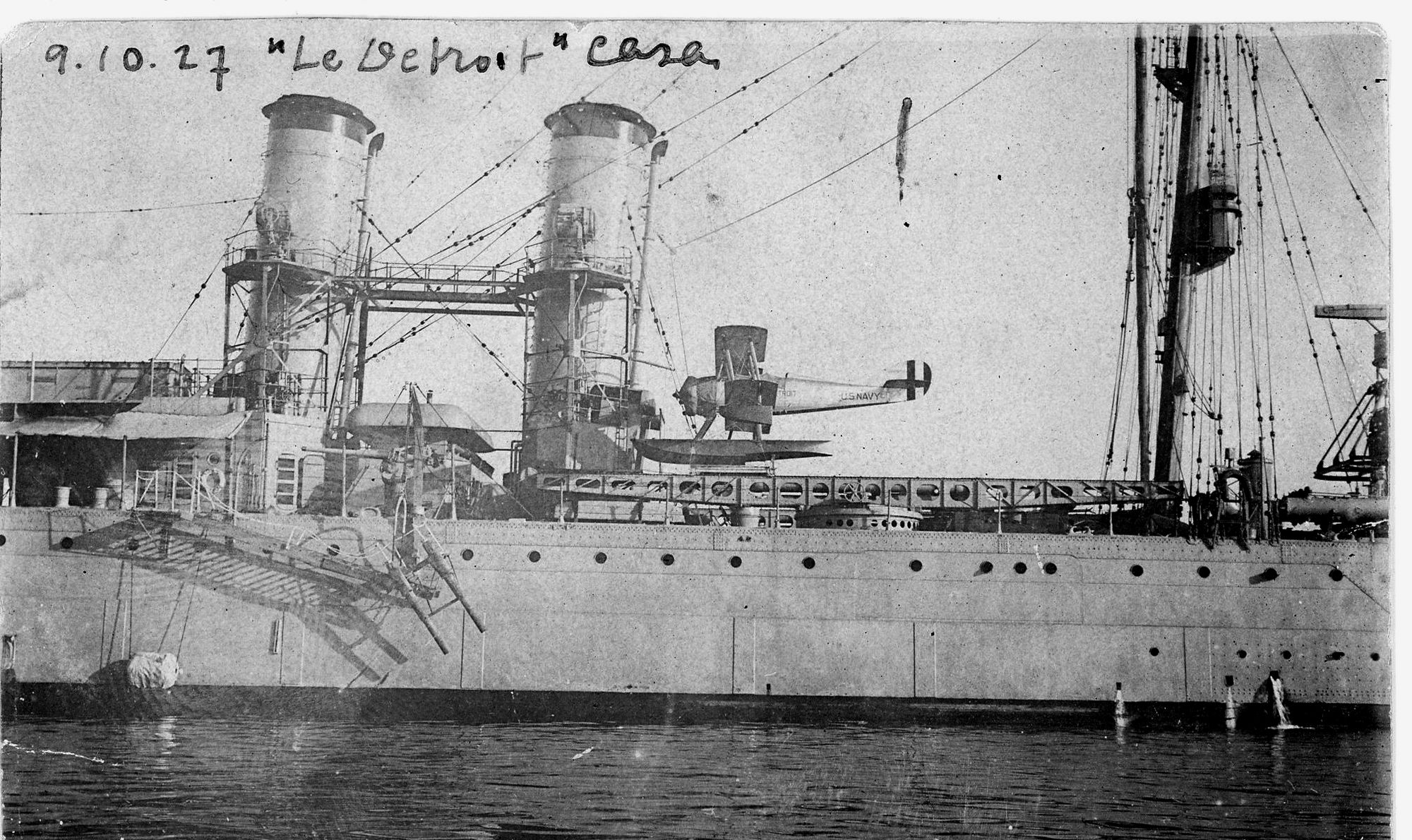
Catalogue number 142039 Vought FU-1 on U.S.S. Detroit, 1927 The basic design of the Vought FU-1 went back to 1918 and it was the last U.S. military wood-and-wire fighter, armed with two 0.30-inch calibre Browning guns. This photograph was taken in 1927 before the single-seater FU-1 was withdrawn from the fighter role to become a two-seater general service and training aircraft. Note the covers on the engine and air vents as well as over the cockpit. U.S.S. Detroit was a Omaha class cruiser and, as the flagship of the Commander U.S. Naval Forces in Europe, sailed to Europe in June 1927 visiting ports in Europe, North Africa (where this photograph was probably taken) and the Middle East. Recto:"9.10.27 "Detroit" Casa" in fine black ink Verso:"Seaplane on the catapult American cruiser "Detroit" in the bay Casablanca" in French and in fine black ink 8.4cm x 6cm Gelatin silver print |
 |
|
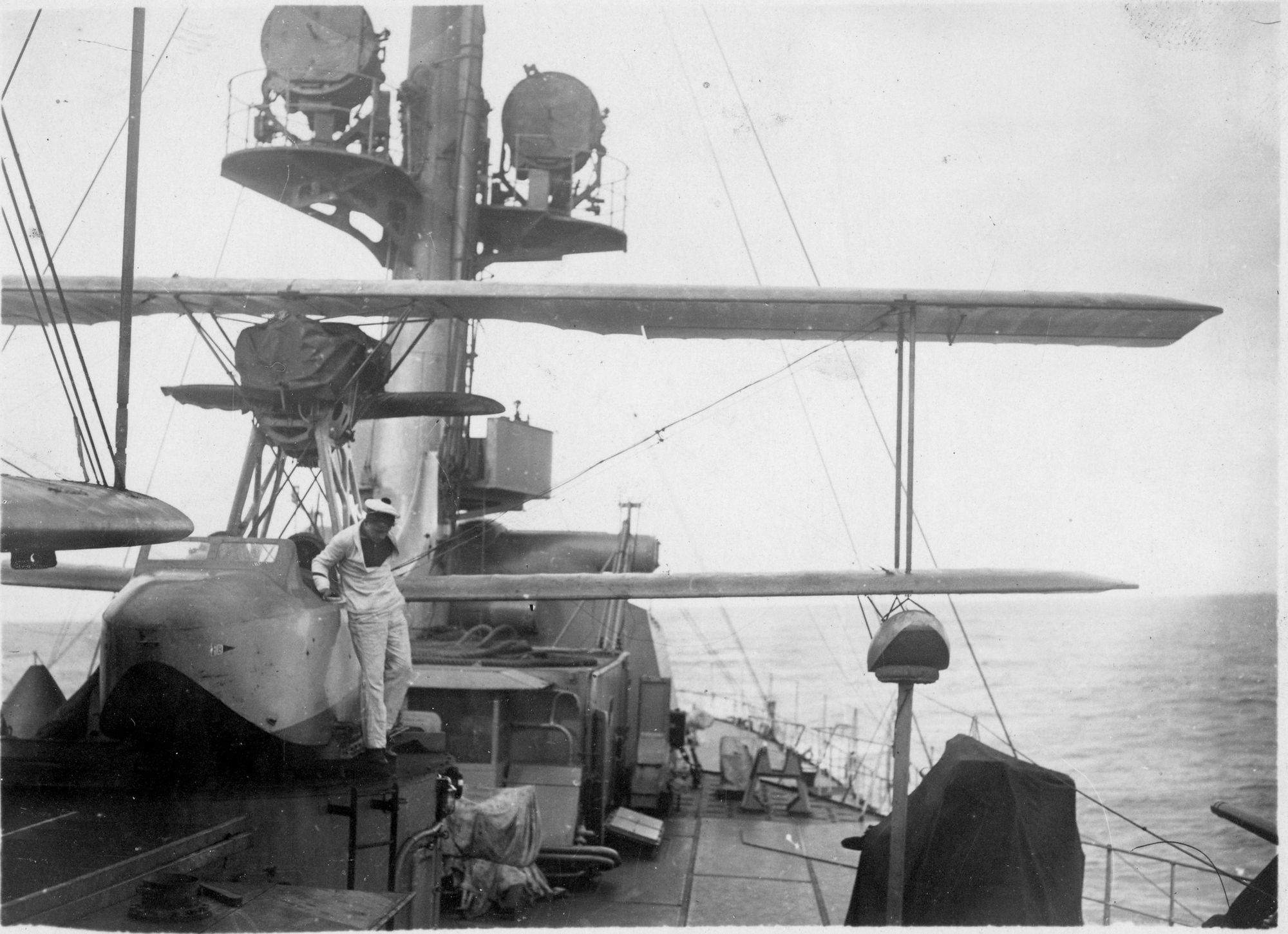
Catalogue number 137101 FBA 17 flying boat on French cruiser Tourville The main features of this 1920s flying boat can be seen in this photograph: biplane with pusher Hispano-Suiza engine and side by side cockpit. This seaplane was very frequent on French warships at the time. The French light cruiser Tourville (commissioned 1928) had one catapult and initially carried two FBA 17 flying boats then the GL-810 floatplane to finish with the much larger Loire-Nieuport 130. This photograph was probable taken early in the career of Tourville as the FBA 17 was associated with training flights and liaison. Verso:"The two seaplanes on "Tourville" in French and in blue ink 10.6cm x 7.7cm Matt gelatin silver print |
 |
|
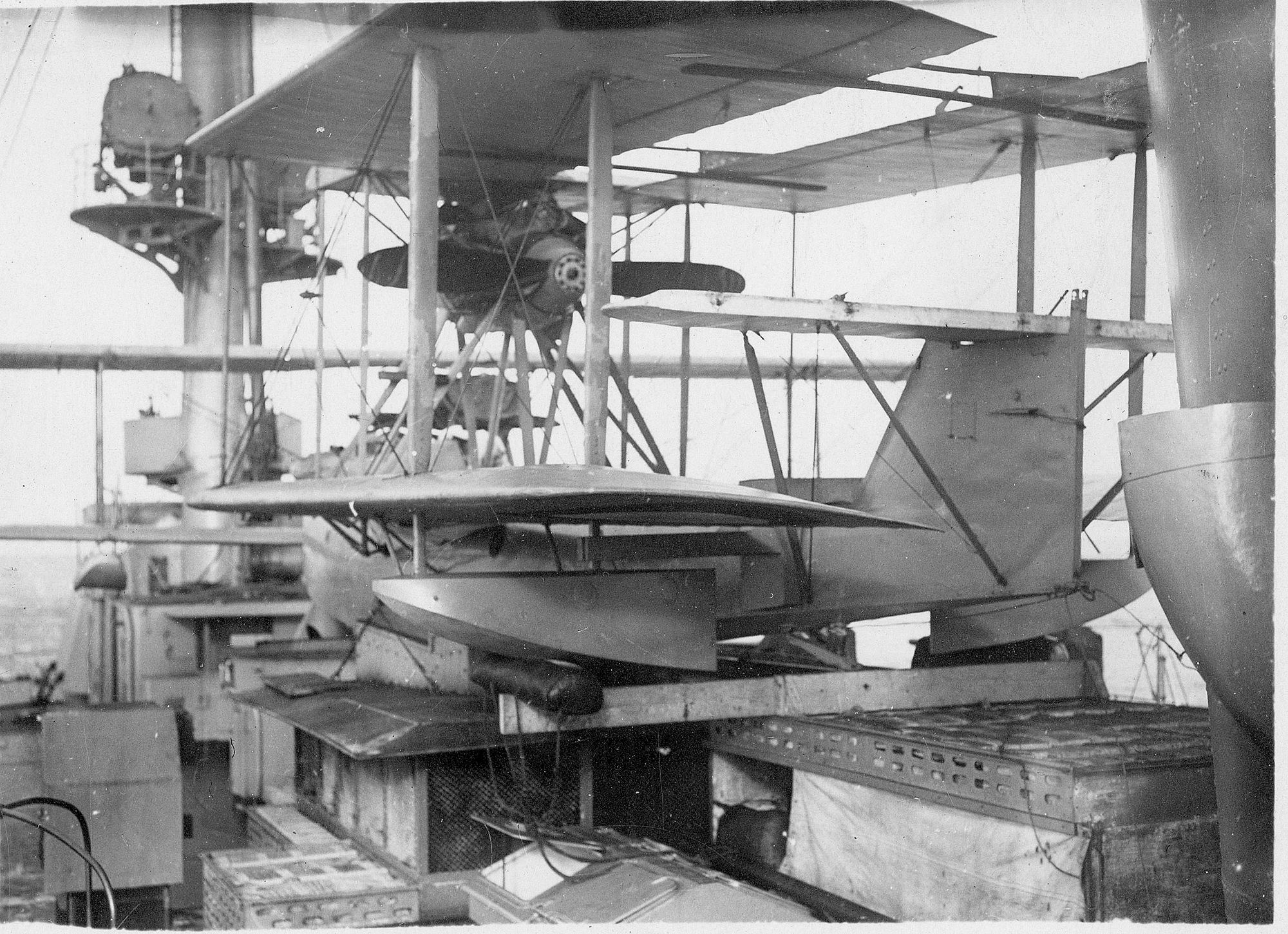
Catalogue number 137102 FBA 17 flying boat on French cruiser Tourville To facilitate storage, the wings of the Franco-British Aviation company FBA 17 could be folded back although on the Tourville as in other French light cruisers, there was no hangar to protect the aircraft from the elements, note the tail has been partially dismanted and the elevators removed, the upper wing in held in a clamp-like support. We have a good view of the pusher Hispano-Suiza engine. 10.6cm x 7.7cm Matt gelatin silver print |
 |
|
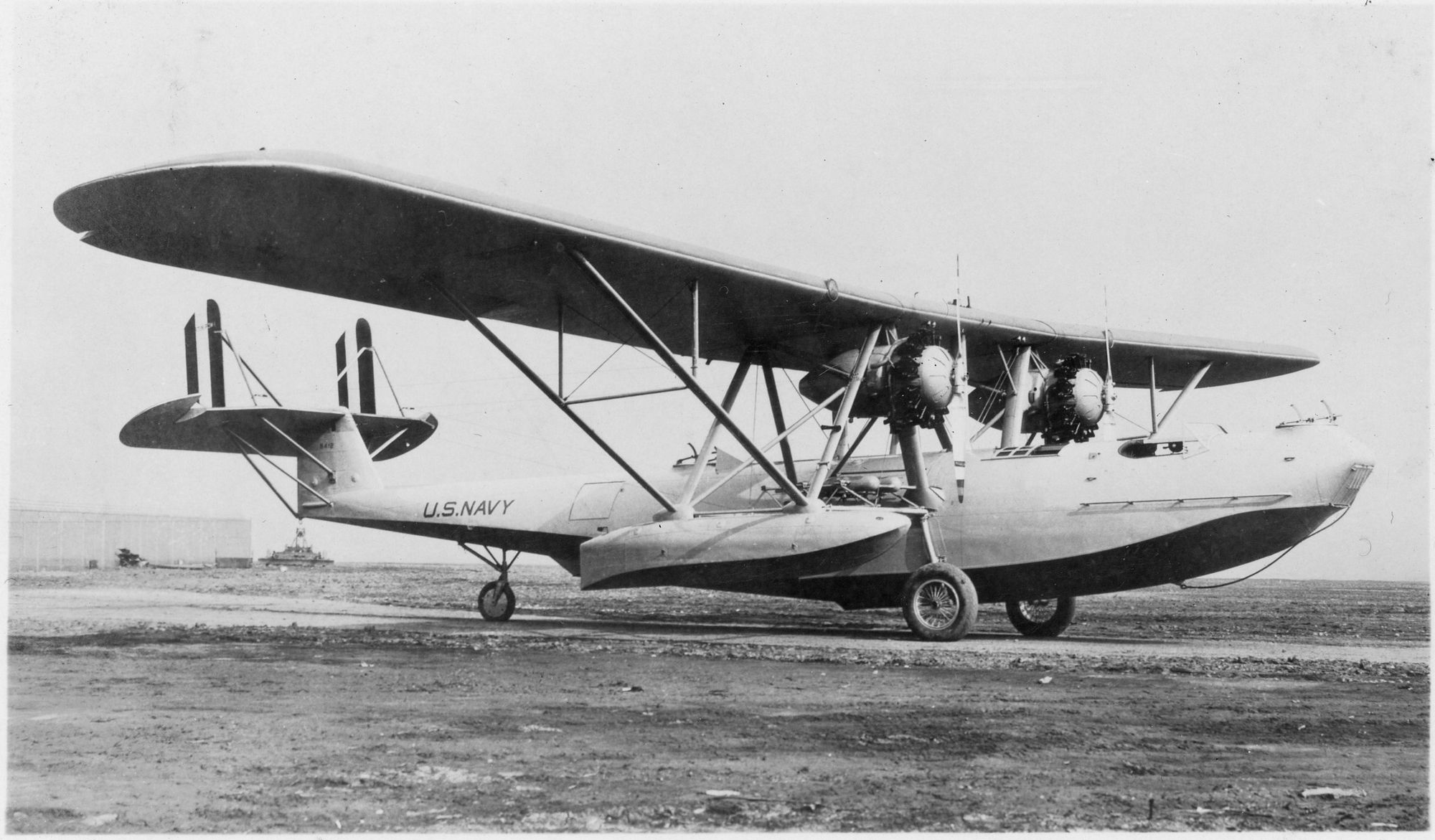
Catalogue number 145048 Martin P3M large flying boat Although a sleek-looking flying boat, the Martin P3M was of little operational use and was relegated to training and liason duties. Martin, however, made up for it and became the sole provider of patrol flying boats to the U.S. Navy after 1945. Credit: Aeroplane Photo Supply, Canada 10.7cm x 6.3cm Gelatin silver print |
 |
|
Catalogue number
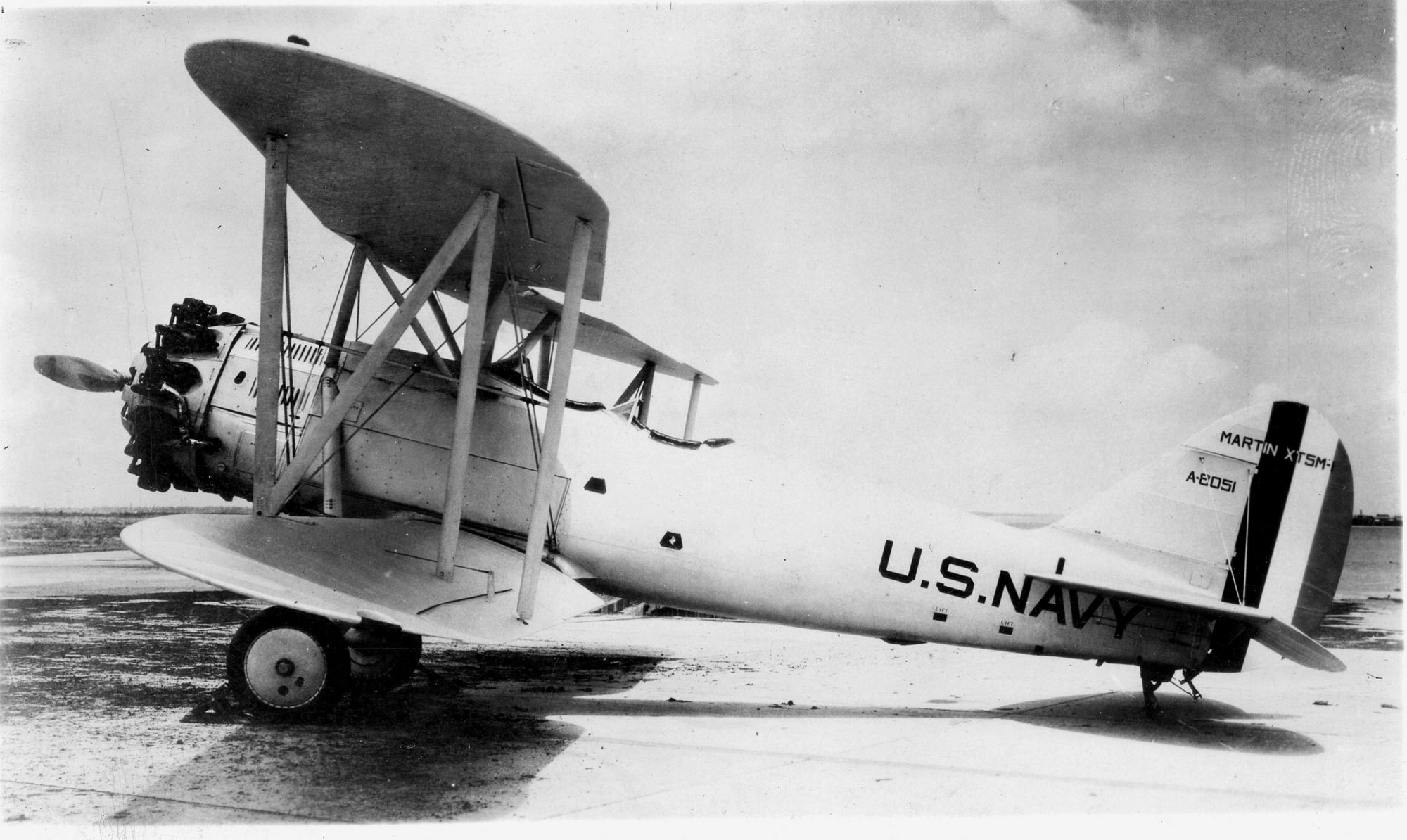
001 Martin XT5M, A8051 This two-man crew aircraft was the prototype ordered from the Martin Company by the U.S. Navy in 1928 when the Navy wanted to develop dive-bombing techniques. It was powered by a Pratt and Whitney R-1690-22 Hornet radial engine. Production aircraft were designated BM-1 with deliveries from 1931 to be withdrawn from the fleet in 1937. Credit: Aeroplane Photo Supply, Canada 10.7cm x 6.2cm Gelatin silver print |
 |
|
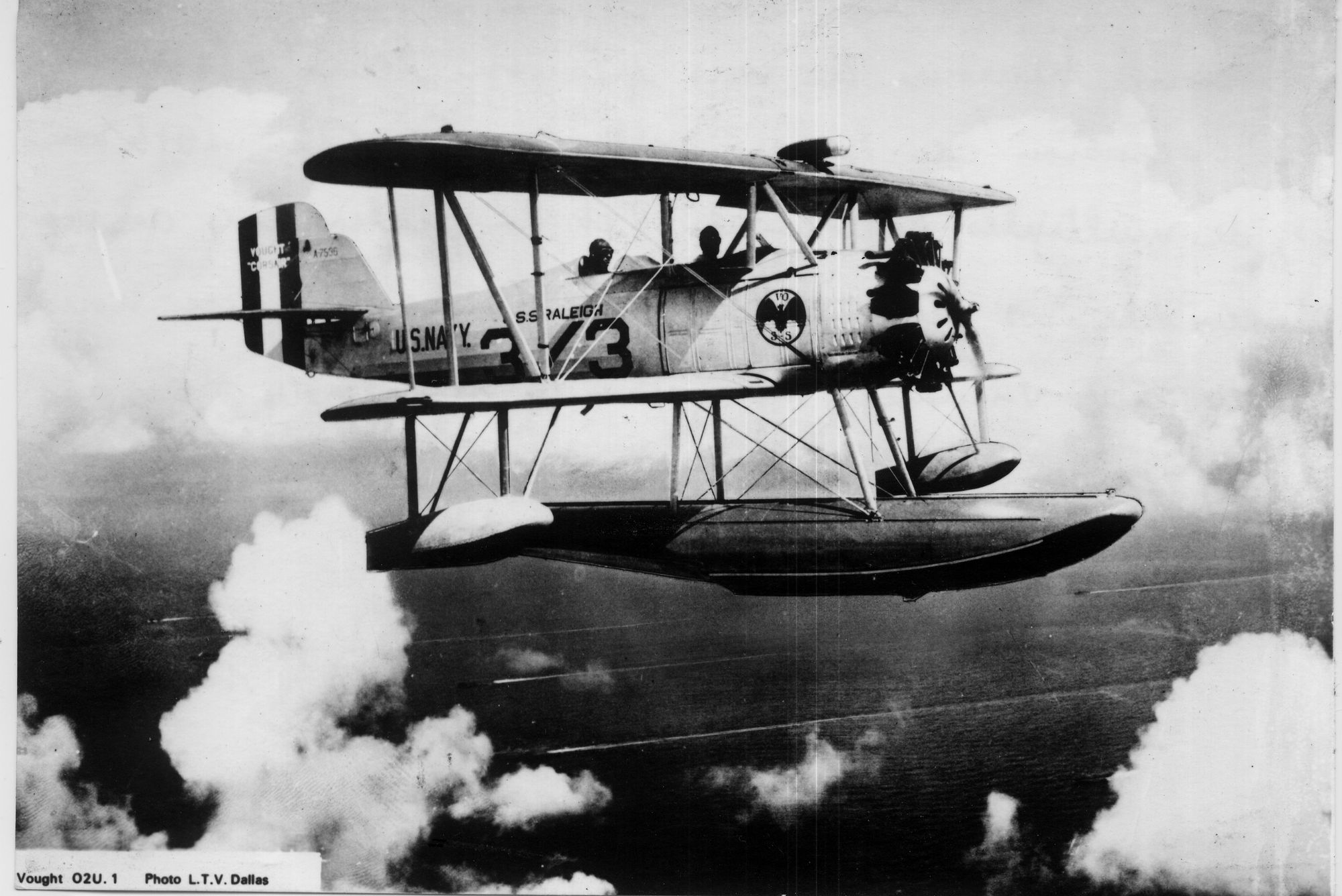
Catalogue number 101118 Vought O2U-1 Corsair, serial number A-7535 from U.S.S. Raleigh, 1928 U.S.S. Raleigh, commissioned 1924 was one of the Omaha class light cruisers, all of which initially carried two Curtiss SOC Seagull biplanes on amidships catapults. These were later replaced by Vought O2U aircraft. 14.1cm x 9.8cm Matt gelatin silver print |
 |
|
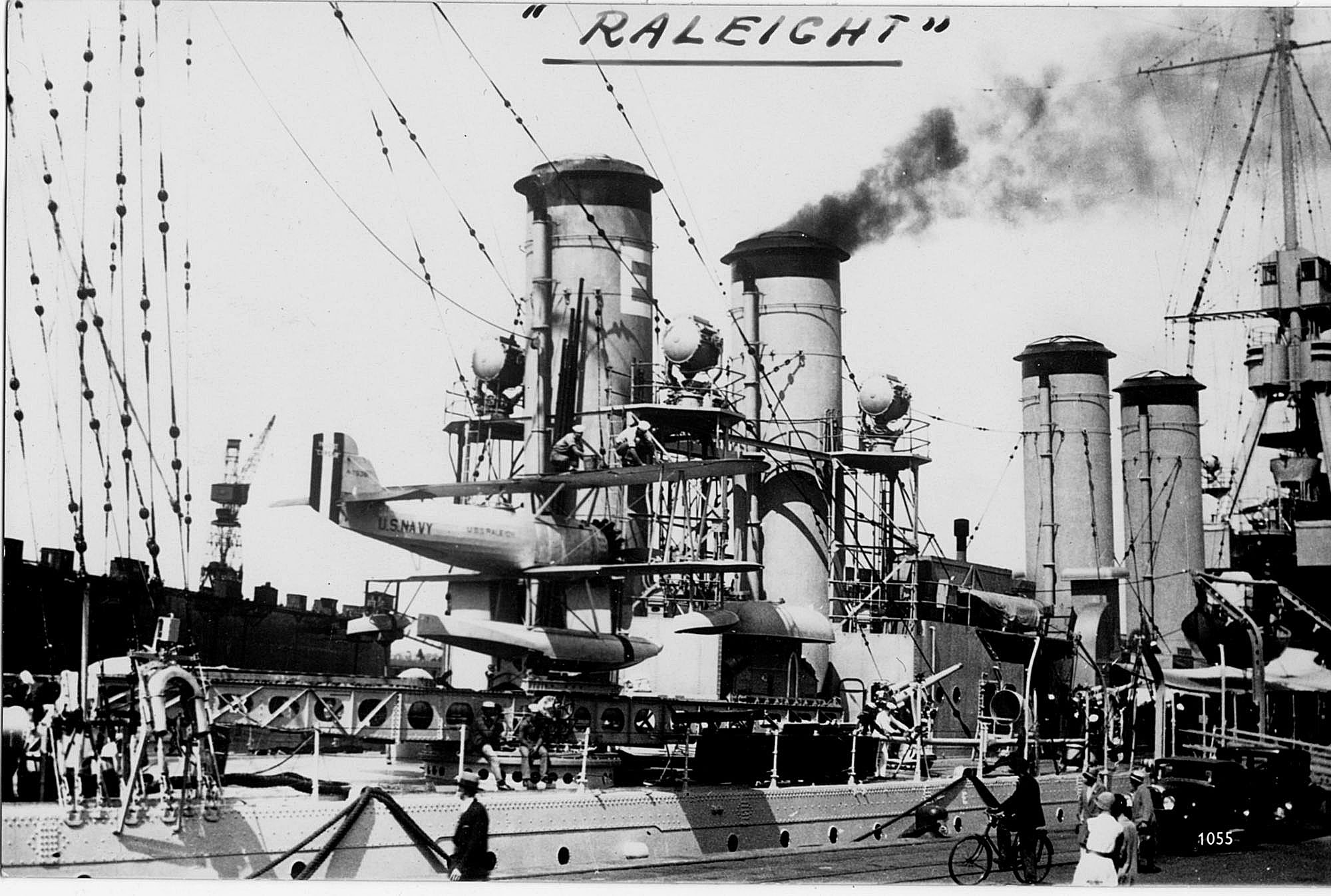
Catalogue number 36136 Vought O2U 1, serial number A-7535 or 36 on U.S.S. Raleigh, 1925 During the inter-war years, the Vought Corsair was the standard U.S. Navy observation aircraft. Crew of two in open cockpits, forward-firing 0.30-inch machine gun and one or two flexible 0.30-inch guns on a Scarff ring in the rear cockpit (Scarff ring can be seen in the photograph). Note the two sailors cleaning the upper wing. 13.9cm x 9.1cm Gelatin silver print |
 |
|
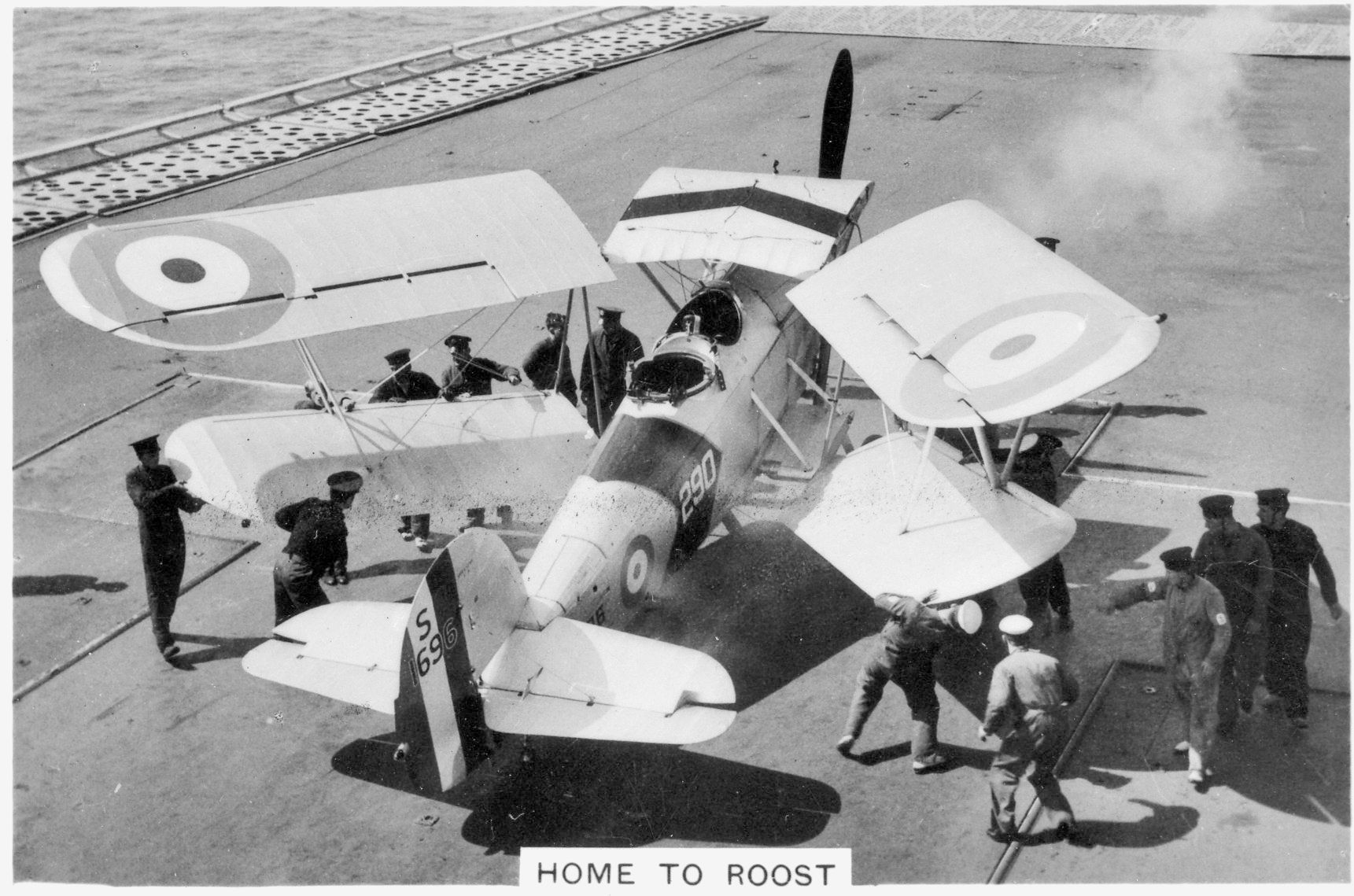
Catalogue number 154114 Hawker Osprey mkIII, S1696, on H.M.S. Eagle S1696 was allocated to H.M.S. Eagle in 1933 moving on to H.M.S. Hermes in 1937. She came to an unfortunate end in 1938 when the engine stalled on landing and crashed into the sea off Bass Rock, Firth of Forth. The pilot Lieutenant J.N. Snow, Royal Marines was killed. The Osprey was a high performance two-seater Fleet spotter and reconnaissance aircraft with a fixed, forward-firing Vickers machine gun and one Lewis gun on a rear cockpit mounting. Verso:"Home to roost. Many of the machines of the Fleet Air Arm are equipped with folding wings to economise in storage space. This photograph taken on the landing deck of the Aircraft Carrier Eagle shows the wings of a Hawker Osprey being folded. This is done before the machine is placed on the lift which lowers it into the hangar, an operation which takes only a few seconds. In order to lessen the landing speed of the plane, the ship steers into the wind." 7.3cm x 4.7cm Gelatin silver print |
 |
|
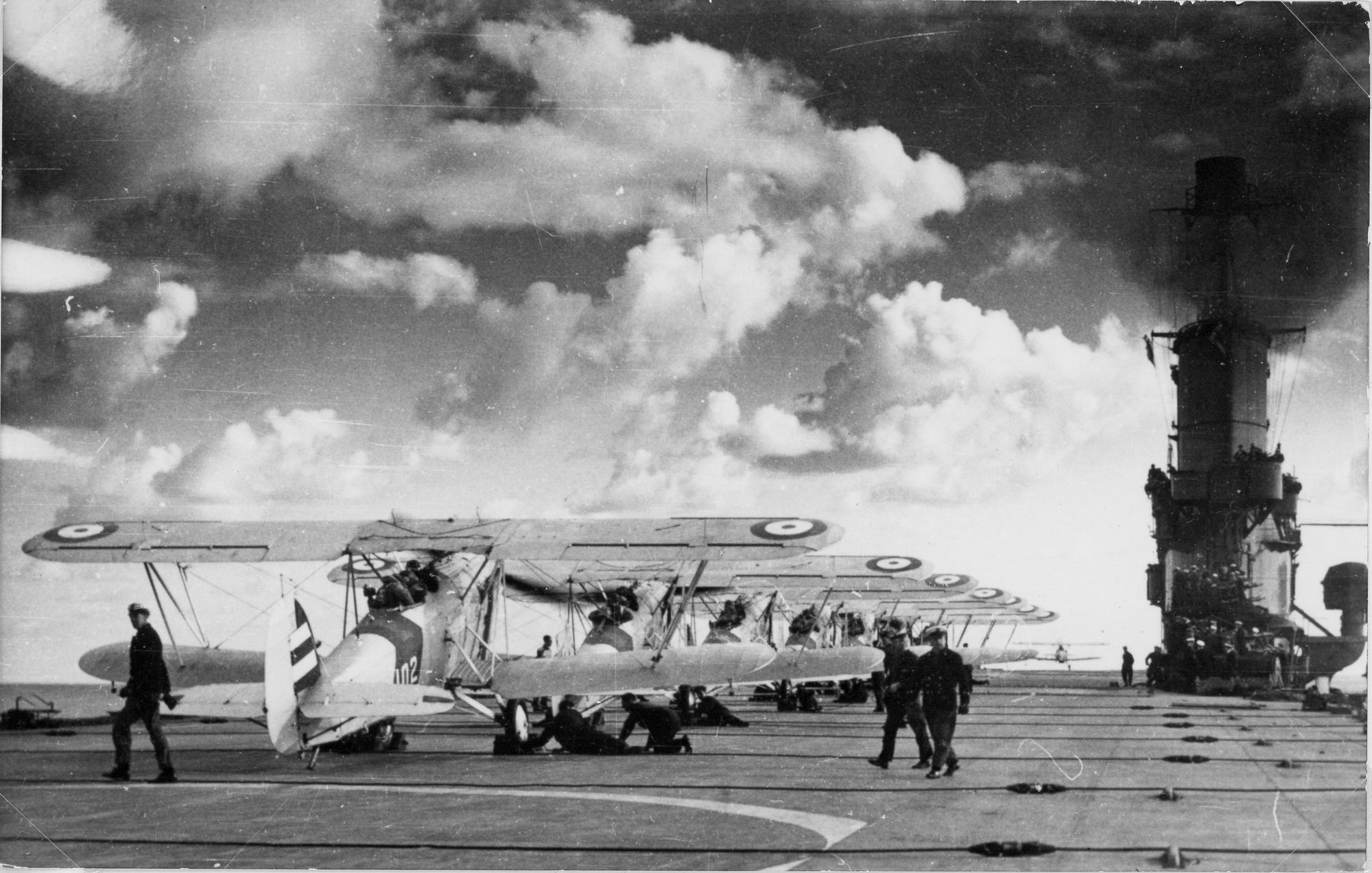
Catalogue number 133141 Take off Fairey Swordfish on H.M.S. Courageous Seven Fairey Swordfish waiting to take off from the upper flight deck of H.M.S. Courageous with an eighth aircraft in the air. The ubiquitous "Stringbag" as it was known did everything the navy asked it to do! Spotter, reconnaissance, bomber, torpedo bomber, could carry depth charges and sea mines plus air-to-surface-vessel radar. H.M.S. Courageous began to carry Swordfish aircraft from 1936 until its loss in 1939. These aircraft have the forward sloping red band markings of 810 Squadron. As for the Fairey Flycatcher, the Swordfish was loved by all who flew it - exceptional handling qualities, low stall speed for landing on with a "firm and instant response" of the controls. Note the crew of three - pilot, observer/navigator and airgunner/wireless operator hunched up together. 14cm x 9cm Modern gelatin silver print |
 |
|
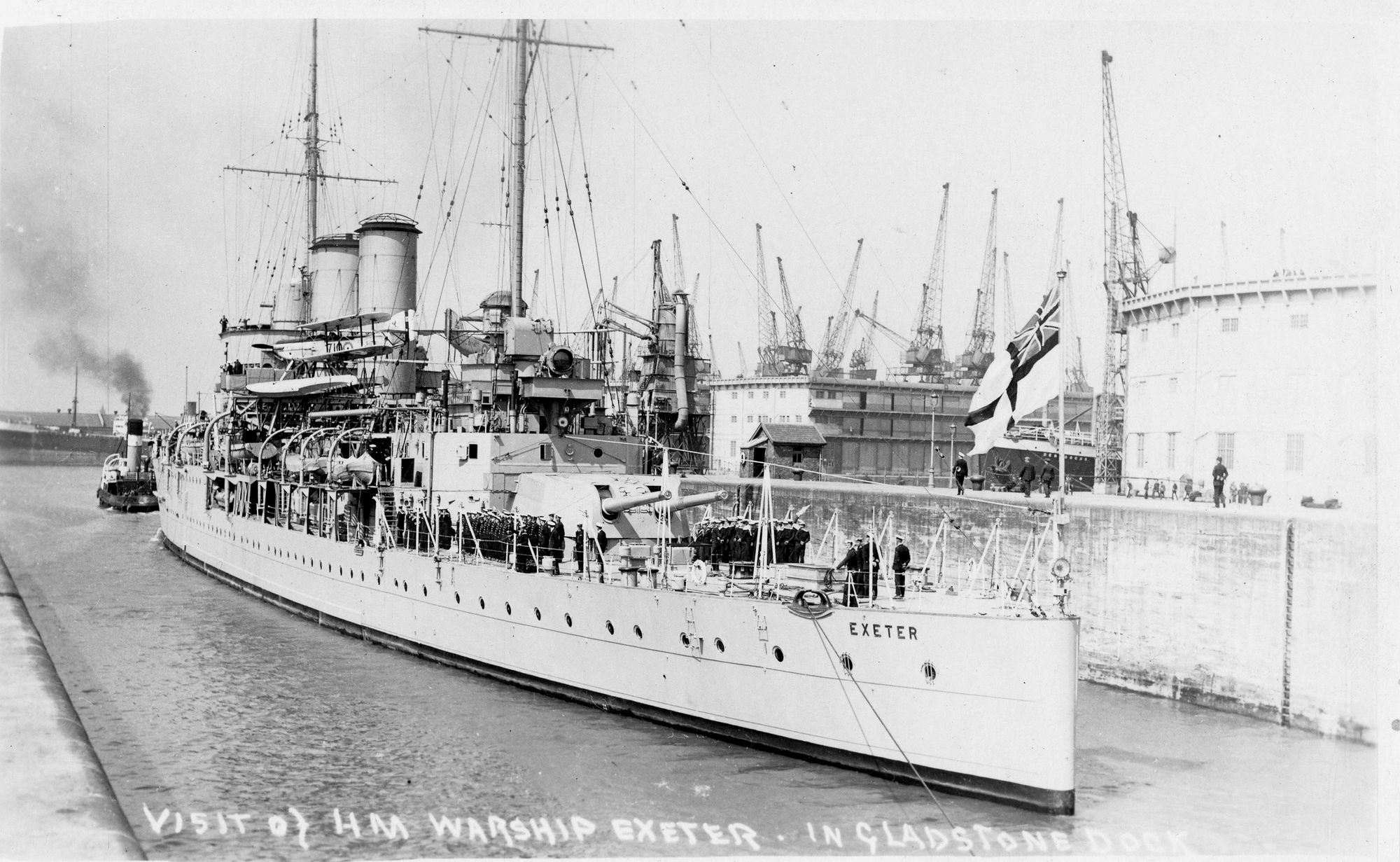
Catalogue number 154119 Two Fairey IIIF on H.M.S. Exeter, 1932 S1781 (port catapult) and S1782 (starboard catapult) were part of Flight 443 for the 2nd Cruiser Squadron and affected to H.M.S. Exeter in 1932 before S1781 moved on to H.M.S. London in 1933. From 1933, S1782 was with the School of Naval Cooperation and was struck off charge in 1935 being uneconomical to repair so we must supose that it had an accident. Exeter was in Gladstone dock in 1932, note the Royal Marines by X turret. 13.2cm x 8cm Gelatin silver print |
 |
|
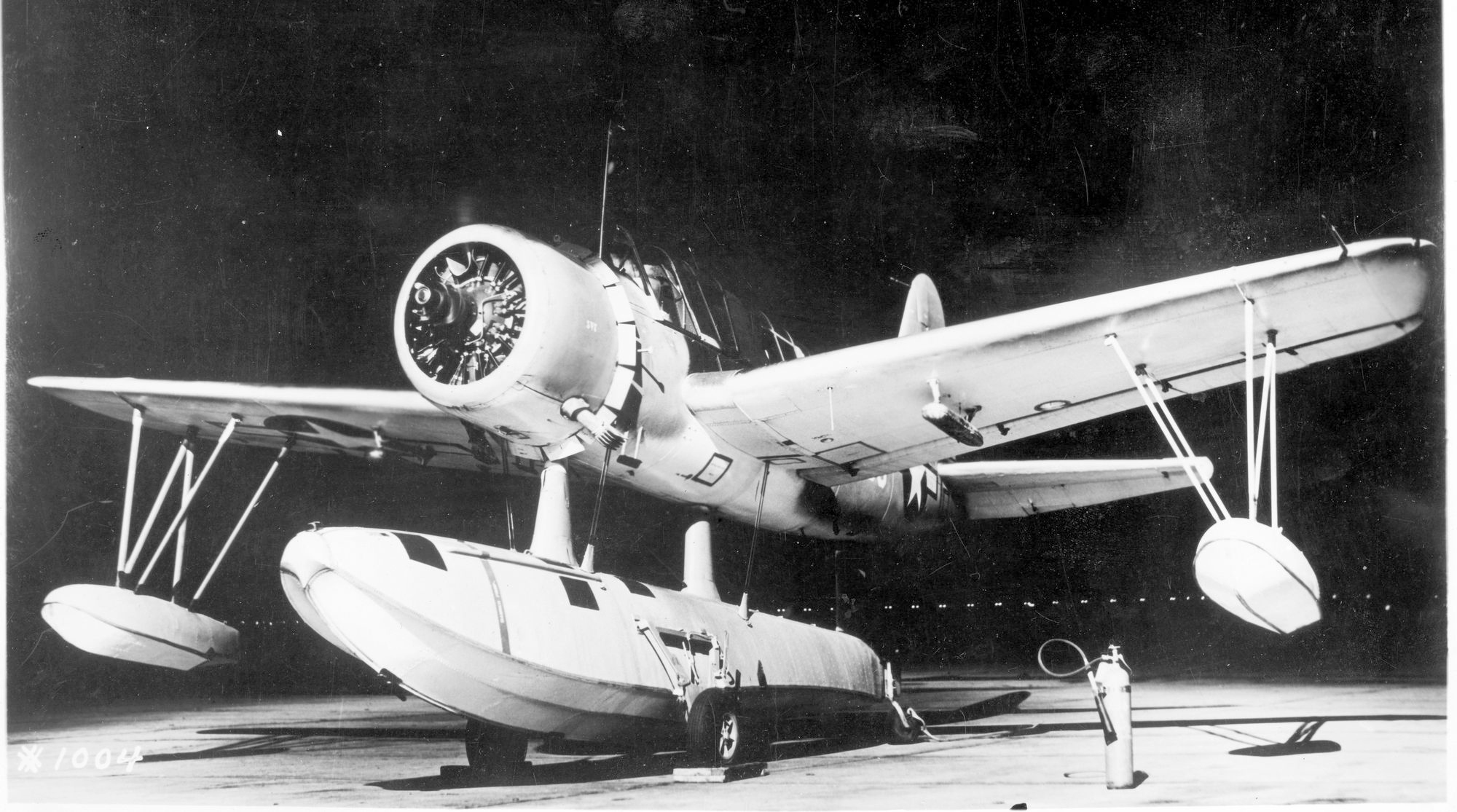
Catalogue number 145016 Vought OS2U Kingfisher The Vought OS2U Kingfisher was a very successful catapult-launched observation floatplane to direct naval gunfire but there are also many examples of air-sea rescue operations with the floatplane staying taking on downed airmen or seamen until rescue ships arrived. In its attack version, the Kingfisher could carry bombs or depth charges plus two Browning machine guns. Note the undercarriage that goes up into the float and no propeller mounted. Credit: Edo Aircraft Corporation, New York 23.1cm x 18cm Gelatin silver print |
 |
|
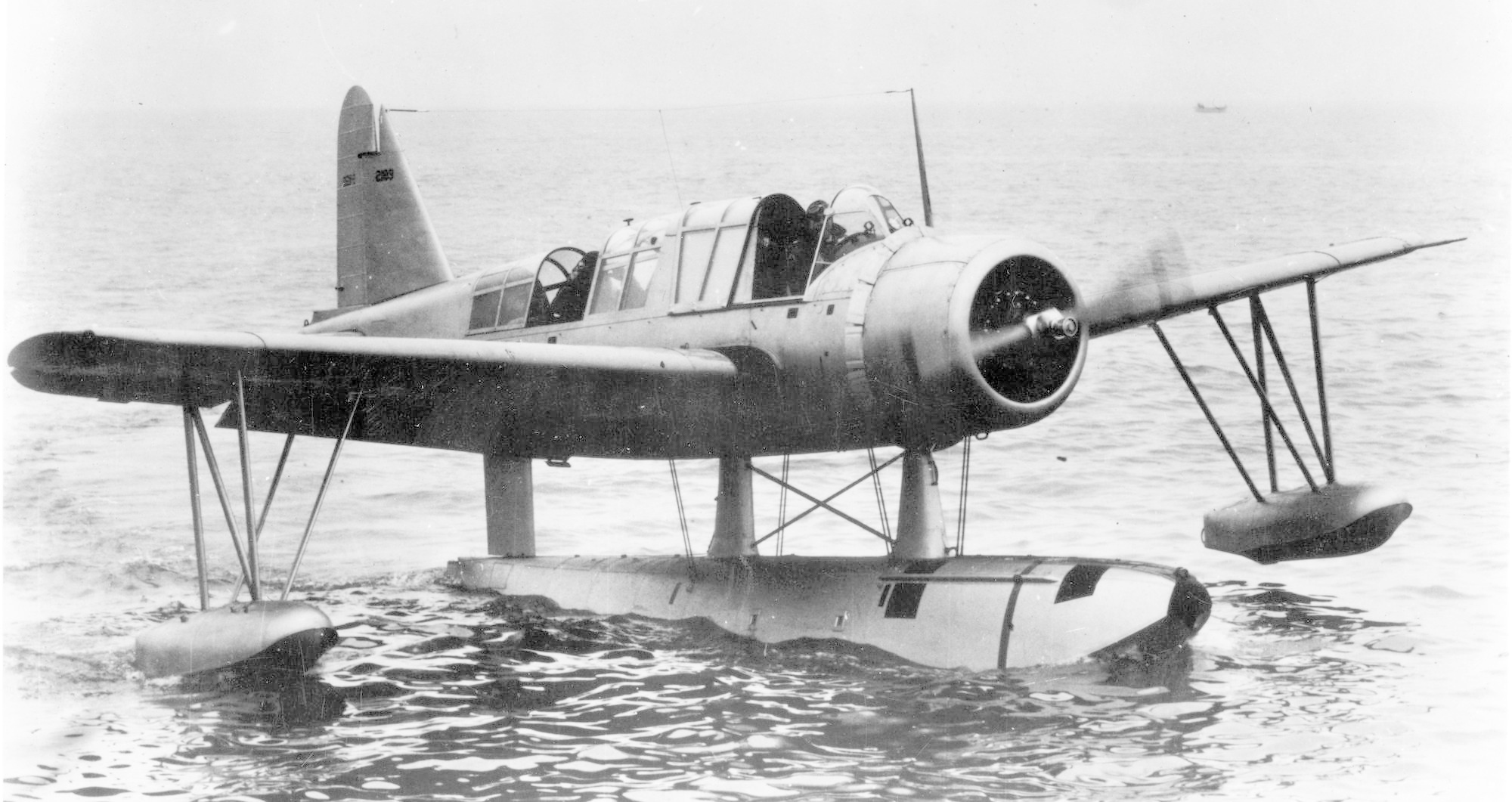
Catalogue number 142021 Vought OS2U-2 Kingfisher, serial number 2189 Vought had a good reputation for designing observation aircraft and the catapult-launched Kingfisher was no exception, fulfilling this role admirably when mounted on warships during World War Two. Kingfisher 2189 was one of the first batch of aircraft ordered in 1939. Credit: Edo Aircraft Corporation, New York 24cm x 17.8cm Gelatin silver print |
 |
|
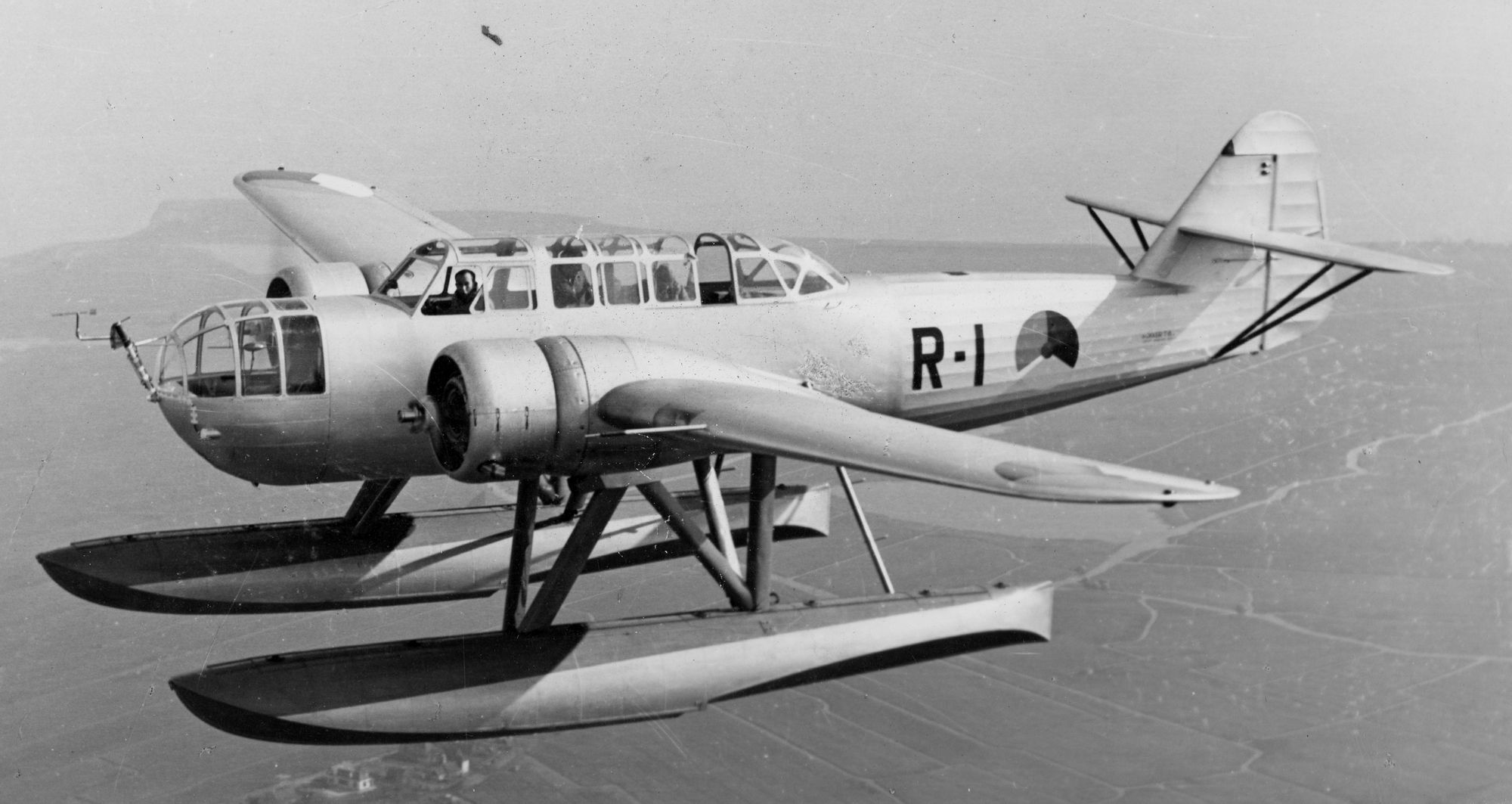
Catalogue number 155043 Fokker T.VIII This Dutch-built aircraft was developed for coastal defence and aerial reconnaissance (hence the large windows in the nose) with the capacity to carry bombs or one torpedo, armement was a fixed forward-firing 7.9mm Browning machine gun at the front of the fuselage and one or two similar machine guns on a dorsal rear flexible mount operated by the wireless operator/gunner. The floats contained auxiliary fuel tanks. The aircraft shown here has the post-1945 roundel of a blue, red and white divided circle with an orange center. With the German invasion of the Netherlands, eight or nine aircraft escaped to Britain via France whilst the Germans completed the airframes left in the Fokker factory and put them into operational service in the Mediterranean Sea. 23.3cm x 17.1cm Gelatin silver print |
 |
|
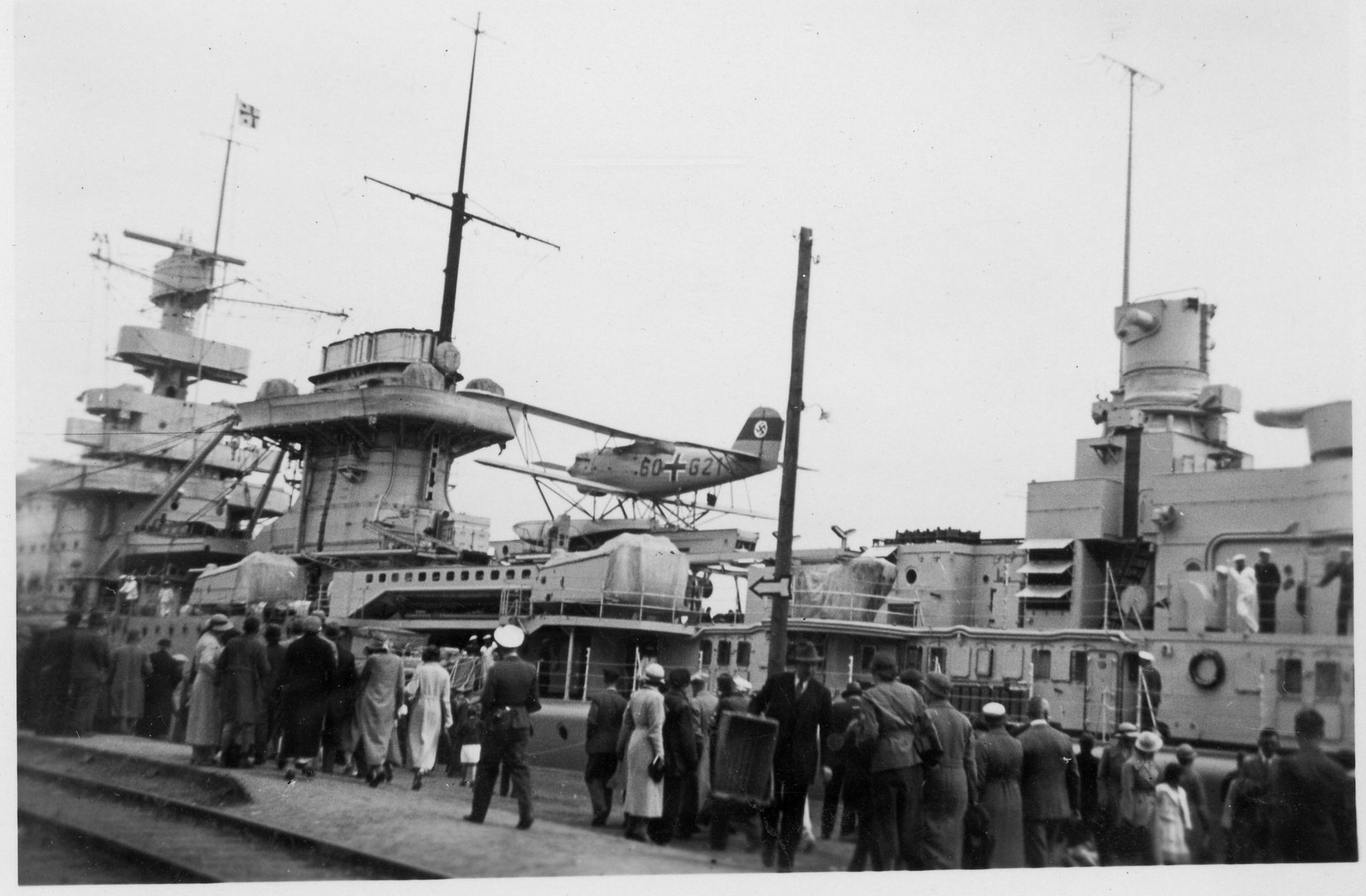
Catalogue number 142009 Heinkel He 60 on German cruiser Nurnberg This photograph shows a Heinkel He 60 on the catapult of the German cruiser Nurnberg around 1934. This reconnaissance biplane operated from battleships and cruisers before it was replaced by the Arado 196. Robust and able to operate from rough seas, it was sluggish and considered underarmed. 8.6cm x 5.6cm Gelatin silver print |
 |
|
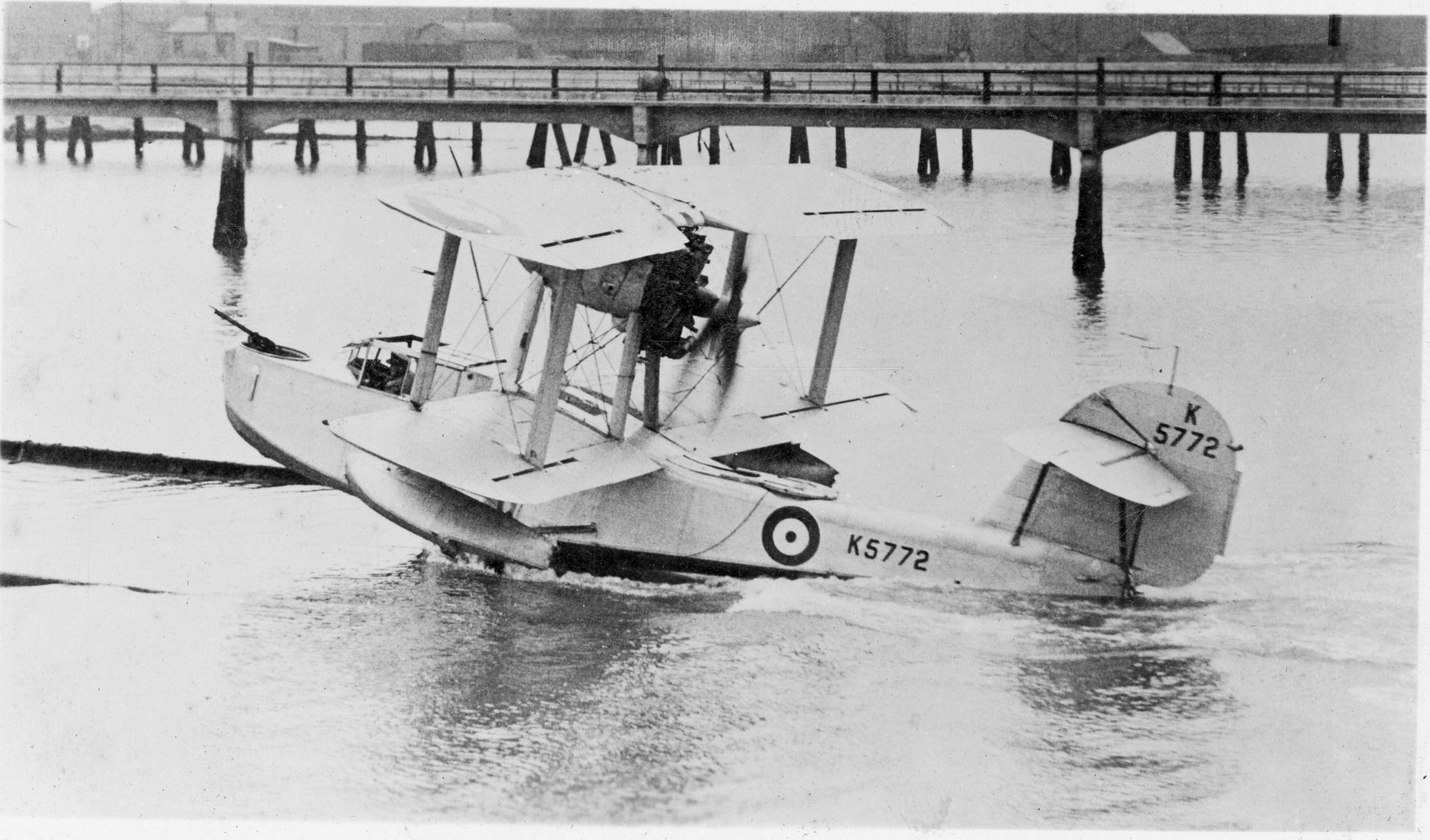
Catalogue number 142050 An amphibious Supermarine Walrus, K5772, 1936 This photograph shows the first production Walrus going up the slipway during trials and demonstrating its amphibious capacity. The Royal Navy initially showed little interest in the Walrus and Supermarine found a market with the Royal Australian Air Force for the early Seagull variant of what was to become the Walrus. From this difficult beginning, the Walrus went on to become the Royal Navy's principle gunnery-spotting and observation aircraft. Note the bow mounted Vickers K machine gun with a mounting for a second gun midships. Credit: Aeroplane Photo Supply, Canada 10.6cm x 6cm Gelatin silver print |
 |
|
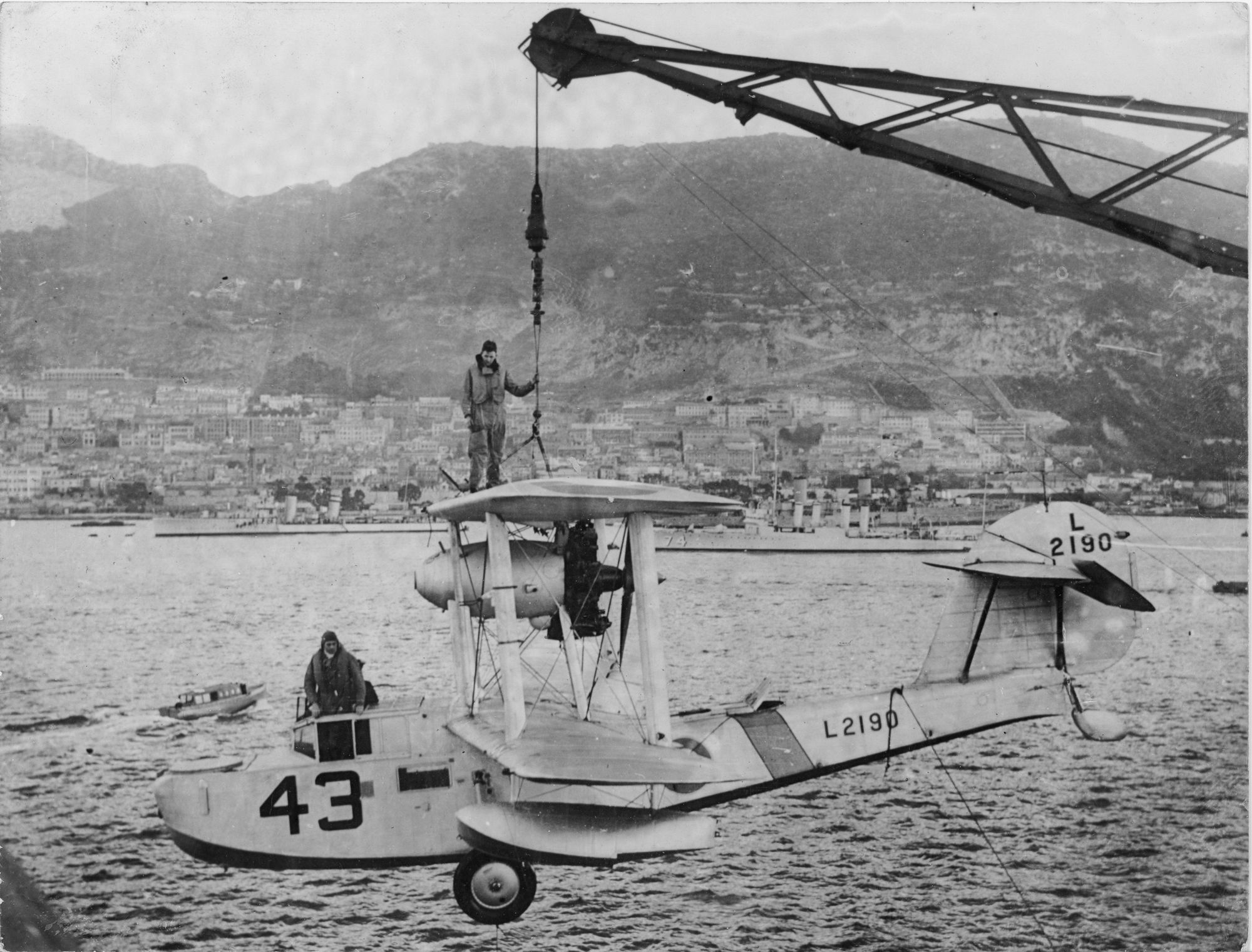
Catalogue number 127046 Bringing a Supermarine Walrus on board The Walrus was catapulted off and then recovered by crane. This procedure required the warship to greatly reduce speed and hence become susceptible to submarine attack. The crew of a Walrus was pilot, navigator and one or two wireless operator/gunner, here all the crew are involved in getting the Walrus up and onto its cradle, note the airman having climbed up onto the upper wing to hook on the aircraft. L2190 was delivered in 1937 to H.M.S. Glasgow, on to H.M.S. Cornwall and H.M.S. Birmingham in 1938 before being attributed to the School of Naval Cooperation, 1939 at Arbroath. With the development of radar, the Walrus took on the role of air-sea rescue. 14cm x 9cm Modern reprint |
 |
|
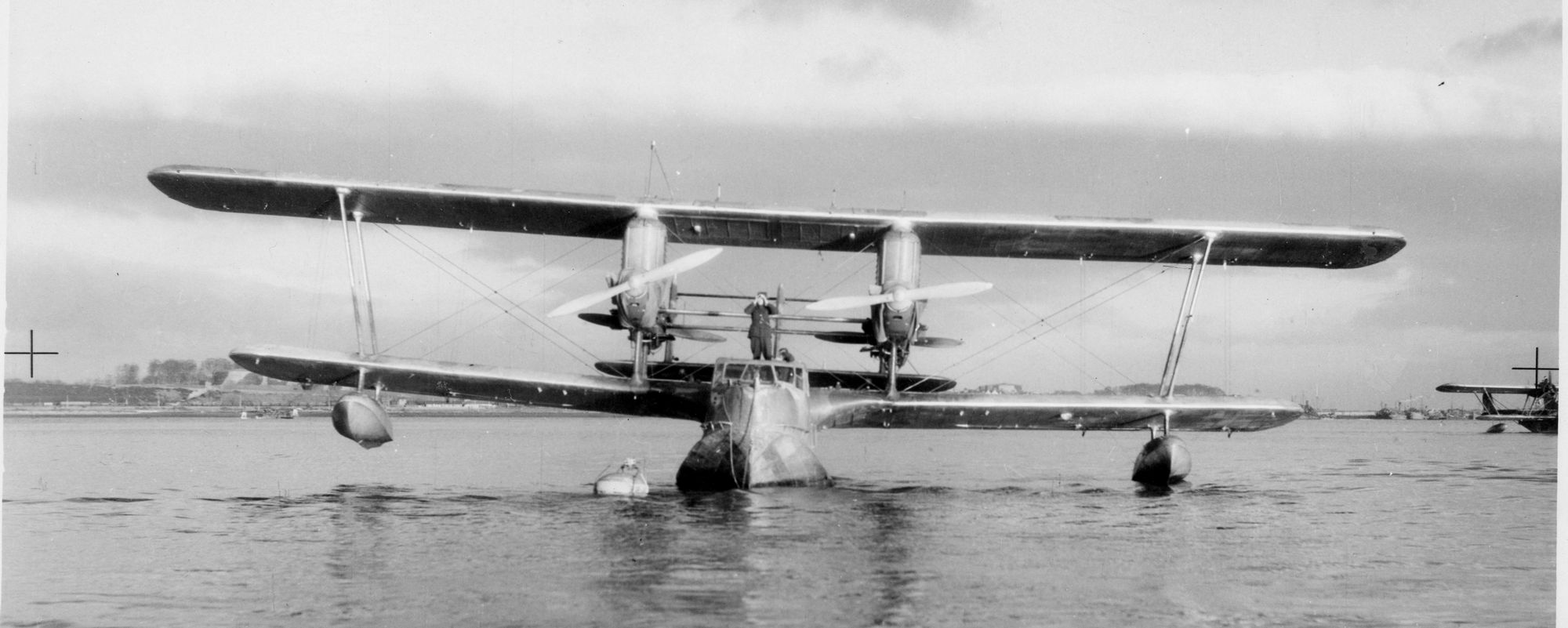
Catalogue number 155056 Short Singapore at Invergordon, 1942 Short Singapore flying boats operated out of R.A.F. Invergordon from September 1938 and this photograph was probably taken in June 1942. The flying boat was powered by two tandem tractor/pusher pairs engined with four Rolls-Royce Kestral IXs. The first flight of the mark III was in 1934 but the concept was dated and the aircraft were obsolete at the opening of the war allotted to only secondary functions such as training. In this photograph we can the very boat-like fuselage and heavy chord wings with thick lower wing roots. Note part of a second Singapore right border. Verso:"Singapore Front View R.A.F. Invergordon. Credit:Crown Copyright Reservec. R.A.F. Official 20.3cm x 15.7cm Gelatin silver print |
 |